03/05/2011

Panorama’s Icon

.

Panorama’s Icon

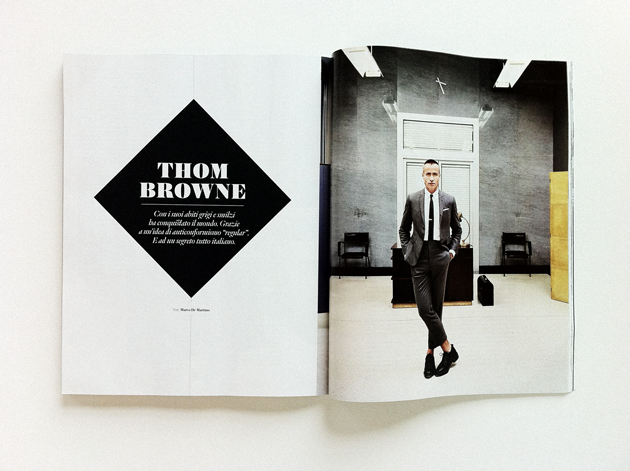
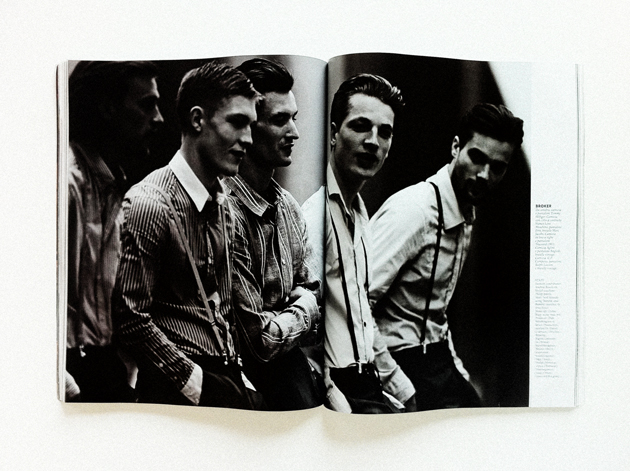
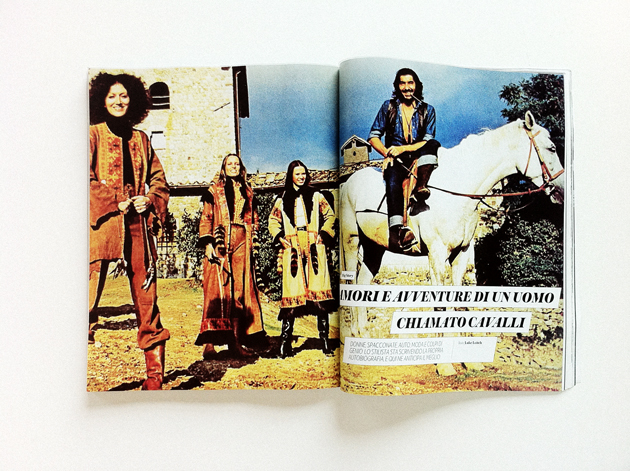
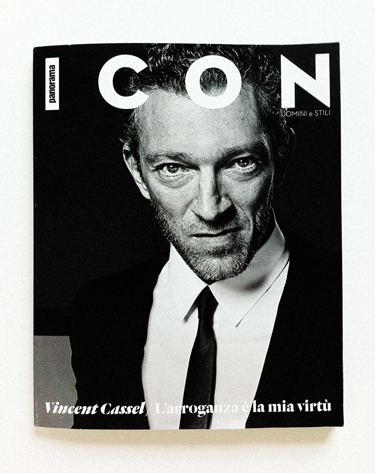
We got our hands on a paper mockup of of the Panorama’s newest magazine, Icon just before it officially hit newsstands on Friday. This shiny new effort is a men’s fashion and lifestyle journal that will instantly join the ranks of serious men’s magazines.

It recalls Esquire, and like that storied publication, evokes a modern incarnation of the cultured, mature, self-realised man the original GQ conquered several decades ago. It covers travel, mixology, and has a nice sartorial bent to its fashion (and provides some handy how-to’s and making-of’s throughout). And in addition to the requisite glitzy editorials, there is an interesting series of articles ranging from musing on the colour black to a look at the mod in fashion. And for this week’s Royal Wedding-crazy audience, there’s even a handy article about Windsors and changing of suit.

We’d definitely call it a welcome edition to the pantheon of distinguished men’s publications.

Contributors to this first issue include Ugo Bertone, Suzy Menkes, James Gulliver Hancock, and many others . And we’re honoured to have gotten our hands on it before anyone else. With cinema villain par excellence Vincent Cassel on the cover, the tone is set for the makings of a new Icon!

Tag Christof

02/05/2011

The Editorial: A Mexican Hipster & Her Acapulco Bike

.

The Editorial: A Mexican Hipster & Her Acapulco Bike

Hipsters haven’t been a cultural minority for quite some time now. In fact, the obnoxiously iconoclast-at-all-cost hipster of yore has ironically been subsumed by his own culture, with even legions of teen girls now burning Lucky Strike and sucking down cans of Pabst Blue Ribbon at “alternative” parties. The famous Adbusters cover of a couple years ago proclaiming the hipster dead proved prophetic, afterall: the term has ceased to mean much of anything, its loose connotations now falling somewhere between 1) the irreverent, self-glorifying eternal teenager embodied in hilarious blog Hipster Runoff (and its countless imitators), 2) suburban kids in garish vintage clothes who have “rediscovered” The Smiths and 3) the design-loving, false-Luddite, artisanal beer-drinking foodie snob embodied in every Brooklynite. Perhaps the one unifying factor among the three is an undying reverence for the fixed-gear bicycle.

Now that the whole world is one gigantic small town in which we all must compete with billions of others, the fight for individuality, however, has taken on special importance. We must all be hipsters at heart, lest we be lost permanently in the crowd. Nevertheless, like so many cultural trends with roots in America and Europe, the hipster’s effect on the world at large has been unpredictable and at times has pitted western cool against the very cultures embracing it. Hipster spread predictably from West Coast USA to western Europe and Britain, and from there onto everywhere else. Now there are Chinese hipsters, African hipsters, Russian ones and Brazilian ones.

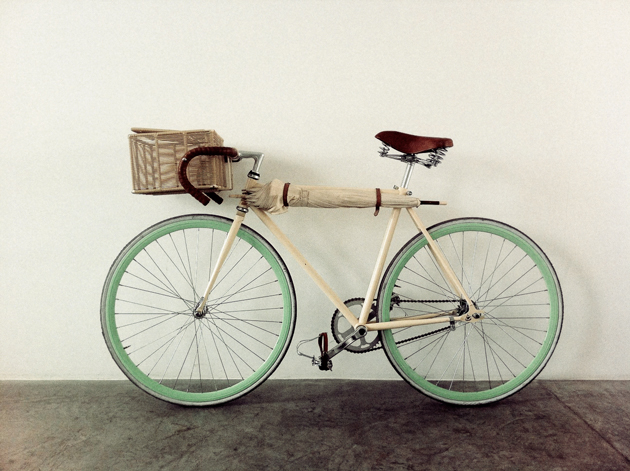
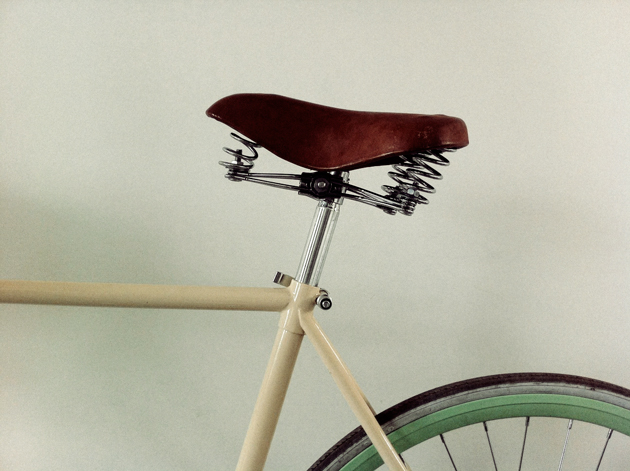
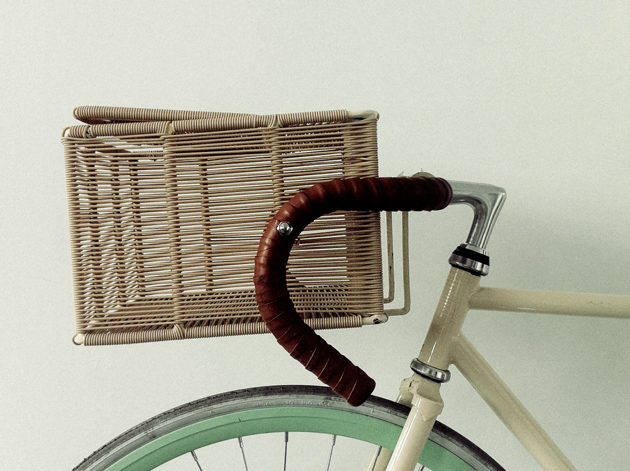
During Salone del Mobile, we had a chance run in with a promising young Mexican designer named Ana Gaby Gonzáles on the metro. We, being qualified type 3 hipsters (see above), approached her because of her particularly gorgeous sea-green fixed gear, which, fortunately for us, happened to have been designed by her. It turns out that the bike itself had a rather interesting story behind it, and since it was a clear sign of hipster’s world reach as well as an interesting design study, we invited Ana over for a conversation.

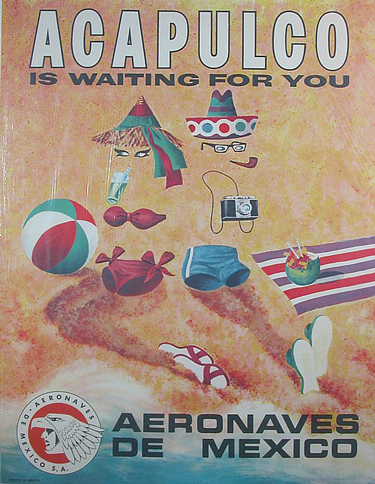
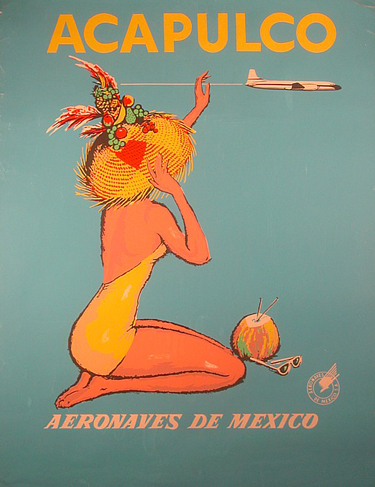
As part of an initiative from Mexico City-based espresso cycles for young Mexican designers to create several one-off bikes representing one of the country’s cities, Ana’s very 1950s colour scheme choice – together with detachable basket and portable umbrella – is an homage to Acapulco. The quintessential Mexican beach destination, which has declined precipitously in recent years, was the designer’s reach into the lost Mexico from her childhood. The problem is, one would never think immediately of Acapulco despite its colours: its essential form is fixed gear minimal and thus says “urban America” in the same way a Vespa painted in any colour says “Italy.”

Ana’s bike instead represents the new and strong cultural mixing that has erased borders in the internet age. Hipster has taken hold in Mexico, and as such, has itself become a part of Mexican culture. The fixed-gear community in the country is now large – check out Mexico Fixed – and well-established. And while the bike may be seen as yet another foreign colonisation of Mexican culture, for Ana it is instead a modernising of Mexico while keeping sight of its roots. And with the Acapulco bike’s well-intentioned mission, its importance ultimately lies in considering whether cultural preservation can be reconciled with progress in the first place.

Just like the dead hipster was overtaken by his own overdone individualism, entire cultures must make certain that they maintain a sense of individualism. Mexico, and Mexican designers especially, must therefore strive to mine their country’s energy and identity to truly preserve while making progress. With its incredible richness of imagery and rich tradition of transportation devices – from the humble improvised food cart to a deep love for vintage automobiles – there’s a lot of inspiration to be had… Ana and her peers are definitely moving in the right direction.

Ana’s bike (which is now permanently hanging around The Blogazine’s bureau) had previously been featured on Core 77 and in an exhibition from Our Cities Ourselves called Nuestras Ciudades Nuestro Futuro: “2030 Diez Ciudades Imaginando La Movilidad” – catch the video here.

Tag Christof 

02/05/2011

Daniel Sannwald / Pluto and Charon

.

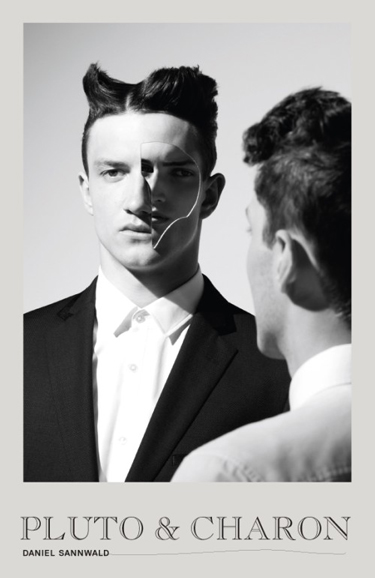
Daniel Sannwald / Pluto & Charon

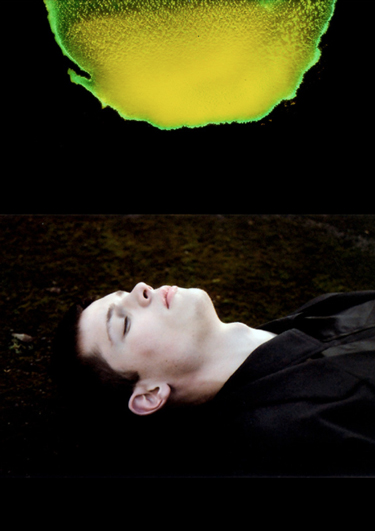
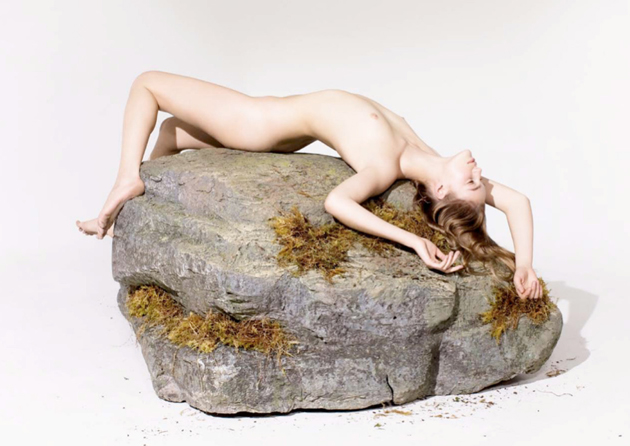
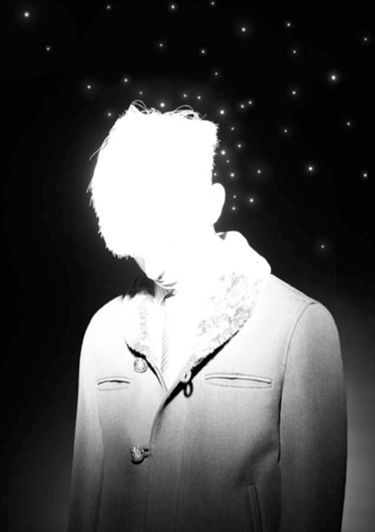
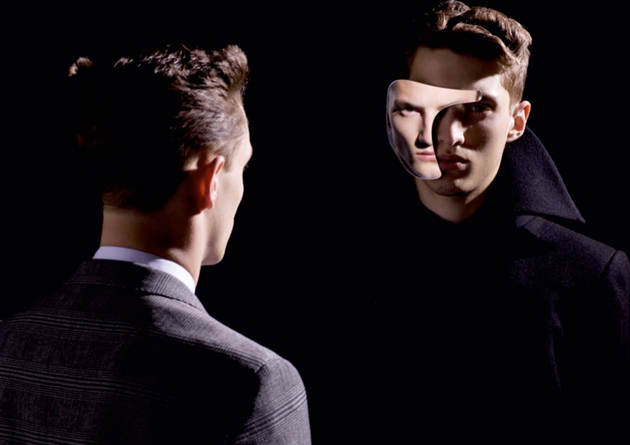
Photographer Daniel Sannwald is force in the making: his fashion work is groundbreaking and dramatic, often exploring themes of the supernatural and the extraterrestrial. He’s appeared in the very best of fashion publications and did an editorial and heart pumping video for Test alongside the lavish stylings of 2DM’s Tamara Cincik. We caught up with him this Friday, just as his exhibition opens at the prestigious Festival Hyères in the idyllic south of France, where he’s currently enjoying a Provençal cottage, local fare and the company of excellent friends. We talked bodily constellations and the cosmos, his new monograph and tea with a very fascinating nonagenarian…

So, your exhibition opens today at Festival Hyères. What can we expect?
The show is curated by Michel Mallard, who I deeply respect. The show will be my work trough his eyes. He made a great selection of works and the room will take the visitors on a journey trough my visual world over the past five years.

Are you having a nice time in Provence?
I rented a nice country house with some friends from London. Its a wonderful house with a huge garden surrounded by fields and trees. We even have goats in our garden (and goats are one of my favourite animals). Its just lovely. More Friends are arriving from France, Germany and Belgium this evening. It feels like a nice holiday and we are enjoying the time together; grilling fishes, taking boat trips on the sea, reading poems, exploring nature and having late talks at night with wine and cheeses.

“The moon always follows the sun,” the title of the exhibition, is gorgeous and evocative. What’s behind it?
I am fascinated by the fact that things come to you and find you in the right moments. You just need to be aware and open, and not on a search. Last year I experienced the loss of a great love and was unable to understand the concept that the world kept on turning. For me everything stood still and I was extremely confused by the fact that my world stopped, yet the outside world kept on turning. One day in an African bookshop I found a poem titled “The moon always follows the sun.” It gave me much strength at that moment. I thought it would be a wonderful title for my first exhibition and a good link to my book title “Pluto and Charon” and my fascination with the universe…

Speaking of cosmic things, I saw a couple weeks ago on your a href=”http://danielsannwald.blogspot.com/”>blog that you discovered a series of markings on your body that exactly mirror Ursa Minor. That must have been a revelation.
I am dreamer and often I lose contact with the world around me and drift secretly away into my own. The discovery of the star constellation Ursa Minor on my body was very exciting to me. In my head I dream about missions and adventures and about who would solve the mystery of the markings on my body. The universe and its Great Unknown always fascinated me… and adventures too. (of course!)


What other concepts and realms of the mind have you been exploring lately?
You should join my friend Rose and I for our weekly tea parties. She is 90 and the oldest friend I’ve ever had. We talk about lovely things, and great concepts and wonders. Its hard to talk about concepts and realms of the mind without a nice cup of tea.


Oh, and the book! Tell!
It’s my first monograph, which I published this year with LUDION Publishing and Michel Mallard. The book is called “Pluto and Charon” and shows a great selection of my editorial work of the past 5 years.  Pluto and Charon are unusual among planetary systems in that each is tidally locked to the other – Charon always presents the same face to Pluto, and Pluto always presents the same face to Charon. My book plays with the concept of these two bodies, it’s a kind of love letter to what will come, and what has already been.

Thanks, Daniel!

Interview and Introduction Tag Christof – Images courtesy Daniel Sannwald
28/04/2011

William Kentridge / Galleria Lia Rumma

.

William Kentridge / Galleria Lia Rumma

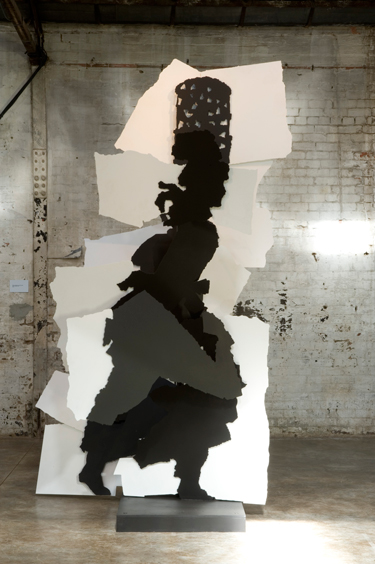
In the International Year for People of African Descent, the versatile South African artist William Kentridge (Johannesburg, 1955) has conquered Milan.

If – unfortunately – you missed the shows at Palazzo Reale (William Kentridge & Milano. Arte, Musica, Teatro) and Triennale (What will come, has Already Come) or the extraordinary version of the Mozart’s opera the Magic Flute at Teatro Alla Scala, staged and directed by Kentridge, you still have the opportunity to see the genius of one of today’s foremost contemporary artists at Galeria Lia Rumma in Milan.

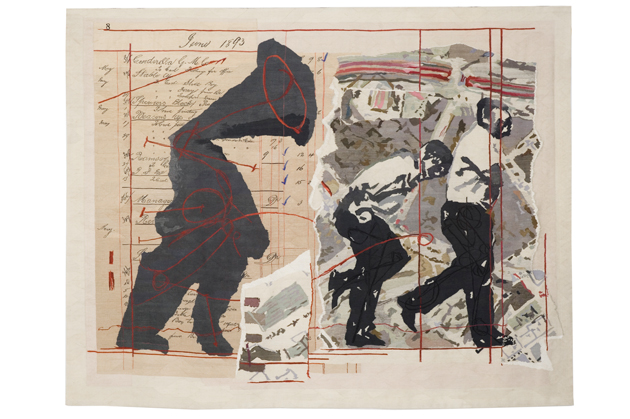
Man with Trumpet, 2010 – Tapestry by William Kentridge, woven by Marguerite Stephens Weaving Studio. Edition of 6.

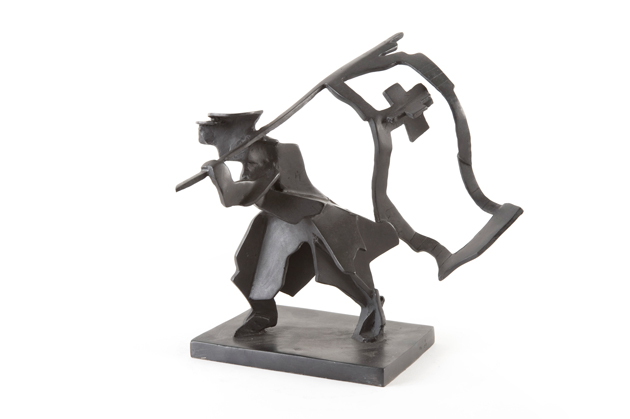
Man with Flag, 2008. Bronze. Edition of 20.

The ground floor of the huge art space hosts 8 video projections inspired by the political and social changes connected with the Russian Avant-garde and by Gogol’s absurd satirical short story “The Nose,” which influenced most of the works displayed in the show. A nose is, in fact, the subject of the small sculptures made of bronze, and a nose is the rider, who travels – mounting a Don Quixote-esque horse – across the fantastic lands depicted on the big tapestries hung on the walls of the first floor. Through his pieces the artist reflects his opposition to the legacy of apartheid in South Africa and his interest in culture of the 19th century and the turn of the 20th. From a pre modern context of writers and intellectuals like Büchner and Gogol he learnt how to understand and portray our chaotic era.

Kentridge uses different media and techniques and embraces all artistic fields: music, movie, theatre and sculpture convey in a total work of art that resume his poetic.


Fire Walker, 2009. Painted steel. Edition of 5.

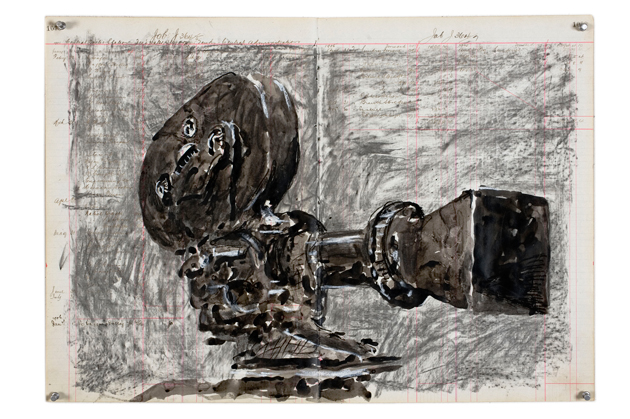
On display at the second floor of the gallery, apart from the sculptures, there are watercolours – sketches for mosaics – Indian ink and charcoal drawings representing olive trees, mythological figures, motion picture cameras, self-portraits, noses and studies for the Magic Flute. The relationship between the drawing and the act of drawing is strong and brings directly to performance as much as tearing paper in small pieces and reassembling them in new shapes is strictly connected with mosaics.

A drawing is always the starting point for William Kentridge, because the flexibility of drawings is like the flexibility of thinking, they have the same speed for him. It is like think aloud.

Camera (Central Boiler Station), 2010. Indian ink, charcoal and pastel on page from central boiler station ledger book.

The exhibition will run until May 14 at Lia Rumma Gallery, Via Stilicone, 19 Monday-Friday 10 am-1.30 pm/2.30-7.30 pm.

Monica Lombardi – Images courtesy Galeria Lia Rumma, All photos credit John Hodgkiss

27/04/2011

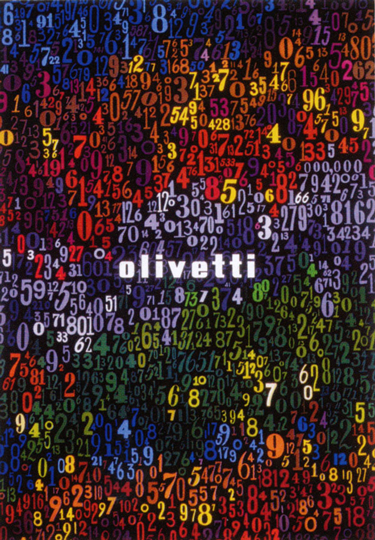
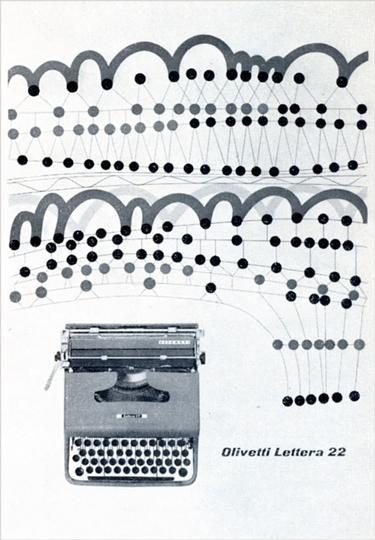
The Typewriter Lives / Rand, Sottsass & Pintori

.

The Typewriter Lives / Rand, Sottsass & Pintori

The typewriter is officially dead. Well, not really. It was widely reported to have died in 2009 when, ostensibly, the last company to produce them, Godrej & Boyce from Mumbai, discontinued production. But the world this week was quick to lament its symbolic and final passing, as Godrej sells its final stock. But as several respectable sources report, such as Canada’s National Post, several producers remain. Because, after all, prisoners and the Amish will always need something to write letters with.

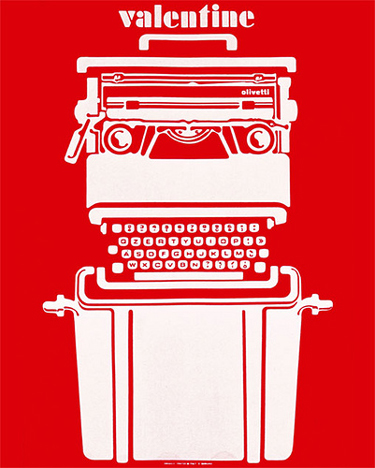
Today, we’re far from the days of the gorgeous Olivetti Valentine and rock-solid, anvil-heavy Smith Corona. It’s not rocket science to understand the lack of demand for the old workhorses over the past several years (or, y’know, decades). But the typewriter is is such a potent archetype that, even though it’s faded almost entirely from use, its complete abandonment is difficult to swallow.

We watched its form merge with that of the computer over the seventies and eighties. And today inside almost anything with a typing interface – mobile phones, computers, car navigation systems – the typewriter’s QWERTY archetype (or AZERTY for you crazy Frenchies) lives on. But as we’ve explored before, the loss of tactility in our new, predominately digital environments isn’t always easy to deal with. Not to mention the exponentially increasing complexity of the objects themselves. The typewriter’s death – real or exaggerated – signals a further uncomfortable detachment from the past.


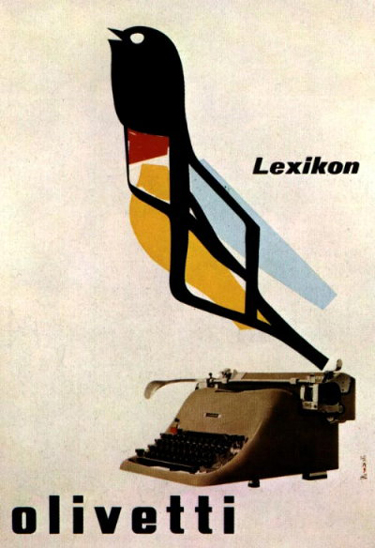
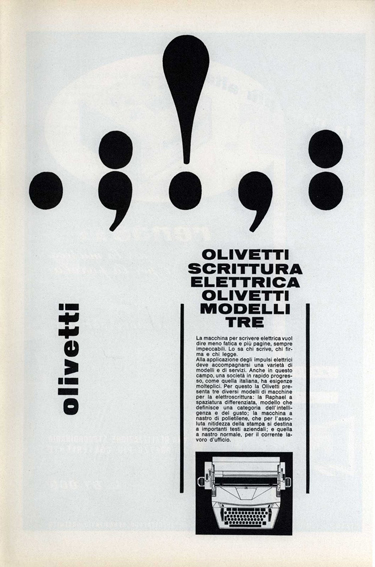
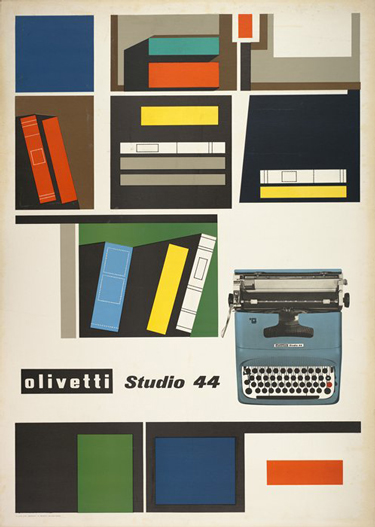
And although we’re most certainly not technophobic Luddites, the culture of the typewriter deserves its due. Its sheer brilliance was capped off by its 1960s and 1970s pinnacle as Ettore Sotsass, Mario Bellini and George Sowden turned them into functional high art. The typewriter was inextricably a part of the creative and visual cultures that made some corporations bastions of good design: think of Paul Rand, Giovanni Pintori and even Sotsass’ gorgeous and imaginative graphic works for the likes of Olivetti and IBM.

Typewriters were sources of great innovation in ergonomics and the relationships between object and user. They brought women into more dignified jobs and paved the way for equal workplaces the world over. The personal computer, in a design sense, can be thought of as an evolution of the typewriter…

Without the typewriter’s influence, it’s impossible to imagine the form the objects we use today might have taken on. Or if they’d even exist. And while not completely dead yet, it’s death is imminent, indeed. Should we fight for it, like Impossible did for Polaroid? Something tells me that wouldn’t amount to a typewriter revival…

Tag Christof – Images courtesy Olivetti, by George Rand, Ettore Sottsass and Giovanni Pintori

26/04/2011

Fifth Avenue Shoe Repair / Autumn 2011

.

Fifth Avenue Shoe Repair / Autumn 2011

From jersey cocoon to aluminium butterfly…”

In seven years, V Avenue Shoe Repair has gone from a small-scale jersey-experimenting designer duo to one of Stockholm’s most intriguing couture houses. And one of Vogue Italia’s design talents of 2010. All without abandoning its traditional craftsman ideals. Quite the contrary, in fact. With the recently revealed Autumn 2011 collection, The Shoe Repair duo, consisting of designers Astrid Olsson and Lee Cotter, has delved deeper into its own aesthetics than ever before.

“We started to look what the great creative minds we admire had done before, and realised that…it wasn’t close to our own idiom, which was kind of a blow…”

Olsson spoke during the recent Stockholm press event about how the team, in its home inside a 19th-century brewery, approached this new collection. They started by trying to use the old fashionable inspiration-tool. To the process, they added a hint of mint, and some strategic benchmarking. But in the end, the most crucial part of the collection’s journey became the use of the archetype archive. By throwing a respectful eye into their own rear-view mirror, they could move their heritage forward. Bring new life to their own past.
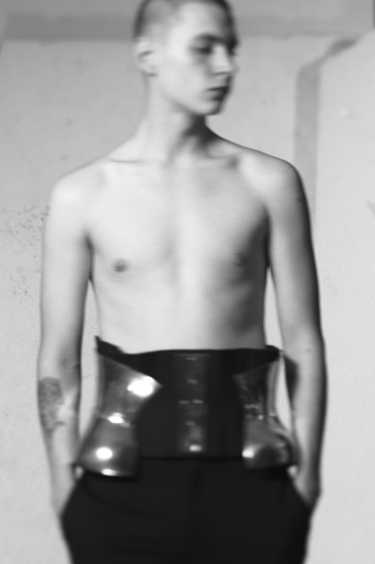
“We have realigned our priorities. We needed to deliver a stronger sensation and expression with the collection, we needed a new tone, a new voice.”

Their usual cocoon-silhouette has been forced to make way for an edgier sex appeal, with a new focus on accentuating body parts instead of treating them as a unit. And where black has always been the label’s dominating colour, some grey, beige and other neutrals have entered the picture.
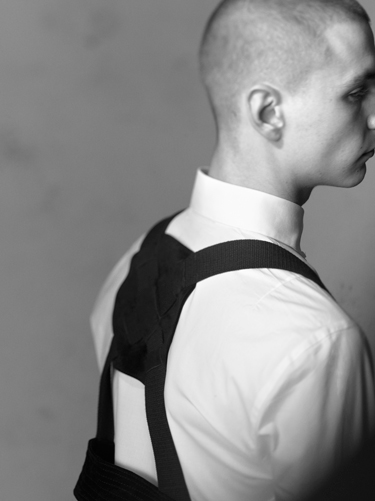
”We realized that even though black is our signature colour, it creates an optical illusion but no details. We’ve worked with pale white, the shade you see before your eyes when squinting…”

The most significant parts of the collection are the atelier pieces all made of aluminium, originally intended to be made out of plexiglas. The hand made corsage is a collaboration with an art student located in Stockholm. We also find spiral shaped armlets, metal shoulder detailing, and a fringed top with aluminium edges.

This collection explores a new world of fabrics and materials. Besides old stalwart cotton, the periodic table is very much present, and represented by elements such as aluminium. Other than that, we find skyscraper platforms in rubber – with rabbit fur-details, some steel, plastic and leather.
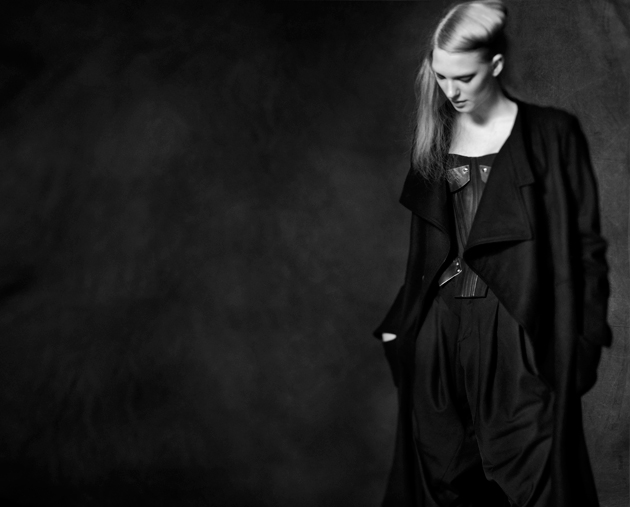
“I used to have the idea that stitchery was defined by the amount of time used in the process, but with this collection, I draped some pieces on a mannequin in 30 minutes…”
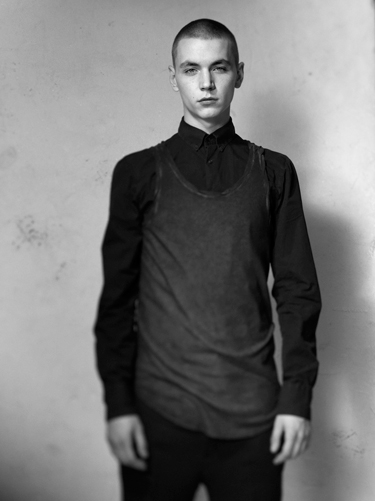
Highly advanced avant garde meets easy breezy draping-techniques – Olsson sums up the collection with these words. VASR are pushing the boundaries of minimalism, to the very sharp edges of a knife. Where they once drew a line between their prèt-à-porter and V Ave Shoe Repair By The No.-couture line, the boundaries are now much less clear… The usually arduous sewing-technics and materials such as cotton and wool are now sharing the runway with the atelier-designs. The “a button here, a pocket-there”-utility standard hooks up with a modern Pierre Cardin-fembot to unite in holy matrimony, utill the next collection do them part!

Petsy von Köhler – Images courtesy Fifth Avenue Shoe Repair
21/04/2011

Bruna Kazinoti & Ana Murillas / Malthe for Hero

.

Bruna Kazinoti & Ana Murillas / Malthe for Hero

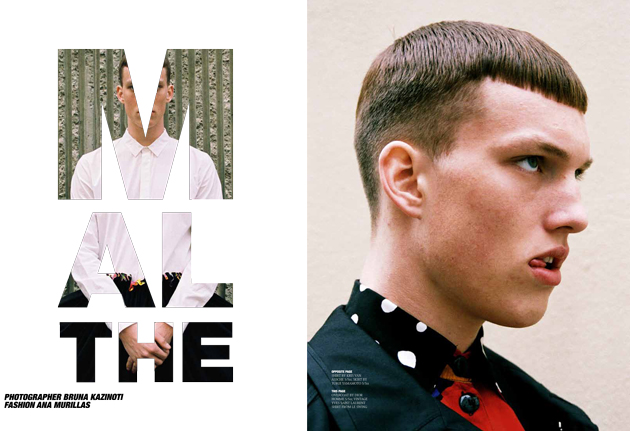
We’re enjoying lots of new magazines this week! Issue 5 of Hero, the young UK zine packed to the brim with gorgeous guys. The art direction is excellent, as always – bold, brash and British – and new issue are always a treat, as they come out only twice a year.


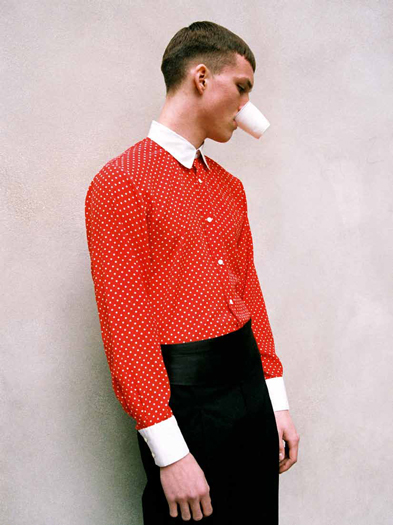
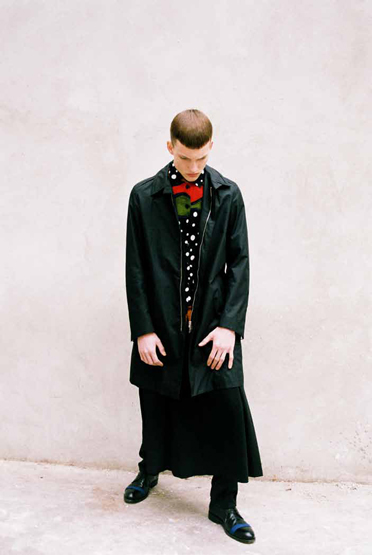
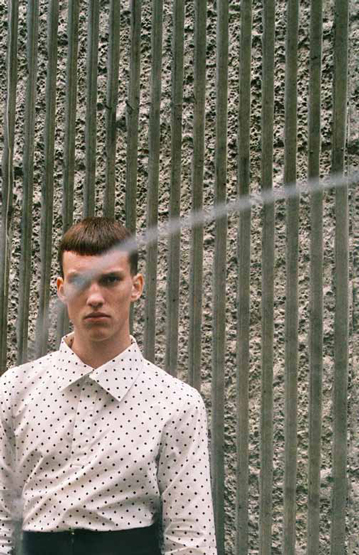
2DM’s photographer Bruna Kazinoti, whose bad boy editorials are a fixture in Hero, shot this feature on model Malthe Lund Madsen from Ford, together with rockstar stylist Ana Murillas. And the two make quite the team!


We’ll let the photos speak for themselves. The mix-up, forward fashion comes courtesy Givenchy, Dries Van Noten, Yamamoto, YSL, Paris Vintage, Dior Homme, Raf Simons and others. Hooray for Hero!

Tag Christof – Images courtesy Hero

20/04/2011

The MegaPhone

.

The MegaPhone

After our editorial rant last week about the decline of tactile, purposeful objects, we hit Salone del Mobile to see designers’ take on the future. What we found was mildly depressing: hundreds of plasticky, computer-generated chairs, mediocre devices from upstart Chinese electronics companies, and show stopping grandiose installations with little bearing on producible objects. The word “artisanal” was thrown about everywhere, but most objects described as such were either high-priced luxury trinkets (as usual) or ignored the influence of modern technology altogether. Not that there wasn’t a lot of excellent work, but this year didn’t give the impression that many boundaries were being pushed.

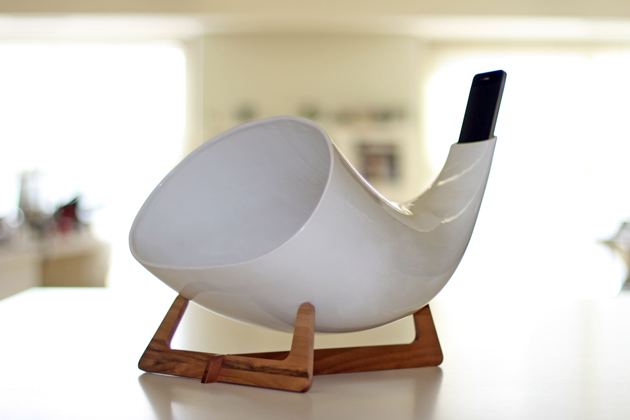
But sometimes a design is so elegant, so straightforward that it stops you in your tracks. Or sings to you. The MegaPhone from Italian design duo en&is for iPhones and iPods is brilliant.

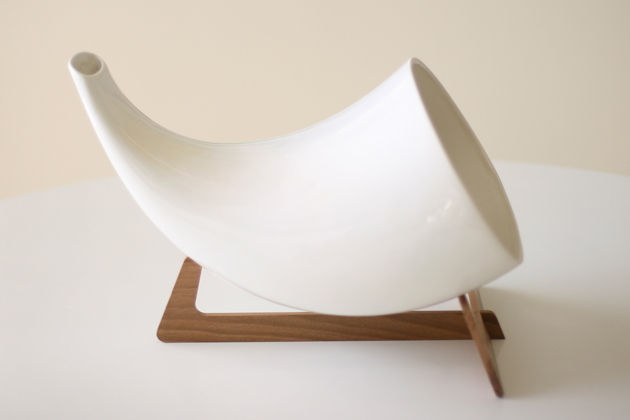
It is exactly the kind of concrete, semi-analogue solution that we crave to see as product design merges with interface design. It is a simple ceramic amplifier on a wooden stand, utilising natural acoustic principles to play music (or inversely, to make speakerphone calls). Its sound is full and earthy, and its form recalls the bells of tribal instruments, antique hearing horns and conch shells. It uses the iPhone’s existing hardware to its advantage (and that’s good design). And while it won’t charge your device, it looks a hell of a lot better than anything that will.

I couldn’t help but looking at Yves Behar’s much-hyped Jambox (also revealed in Milan last week) and thinking that, despite its technical prowess, the MegaPhone is a far superior design. Efficient. Timeless (insofar as the iPhone keeps the same general configuration). Desirable.

It cleverly unites low-tech with high tech, and it transforms the iPhone (while using it to listen to music, at least) into a 21st century take on the parlour phonograph. Now that’s progress.

Tag Christof – Images courtesy en&is
20/04/2011

Vicky Trombetta / Wonderland

.

Vicky Trombetta / Wonderland

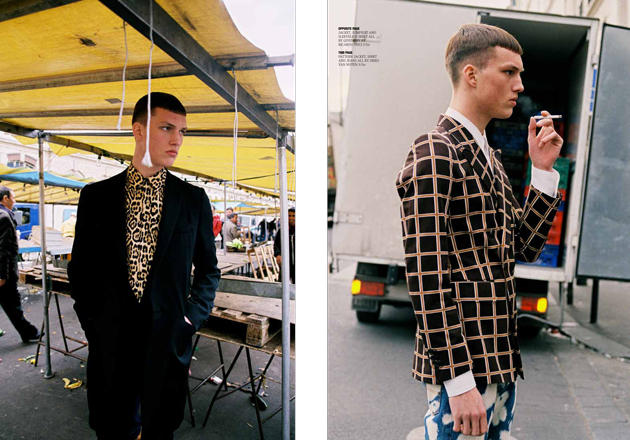
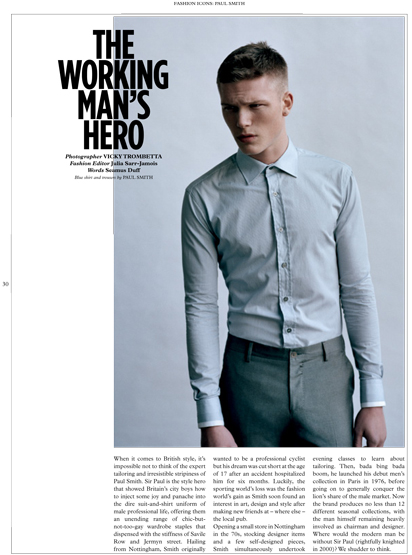
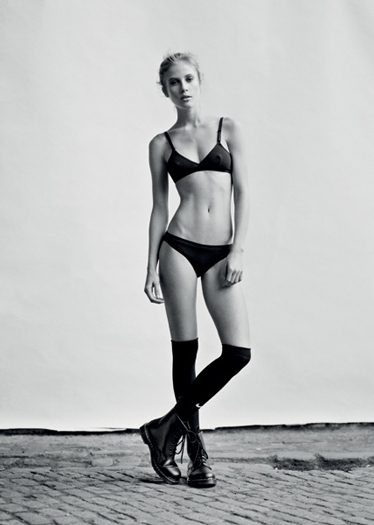
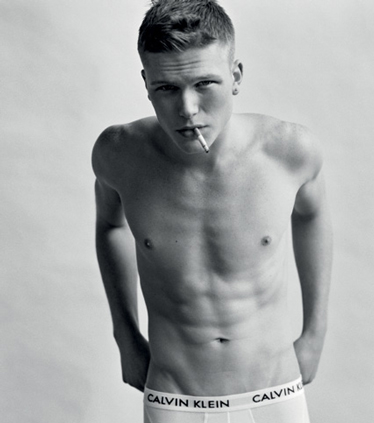
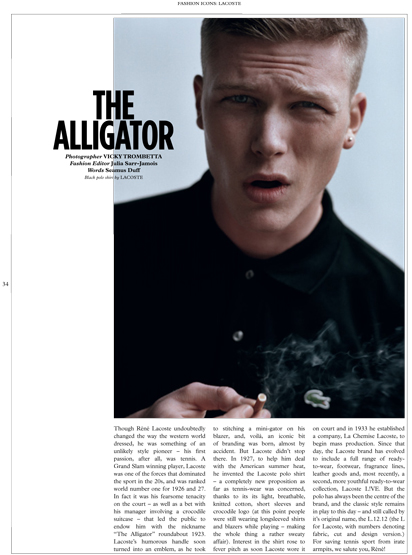
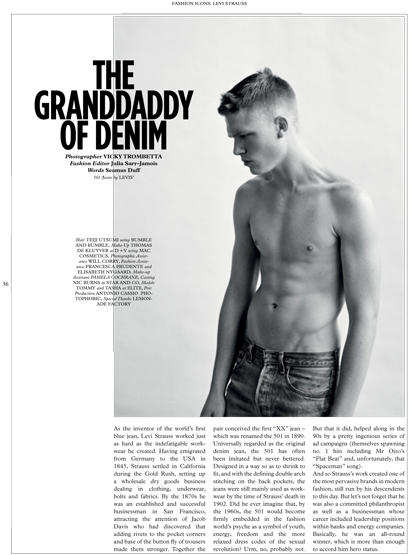
New issues of Wonderland are always killer. And the latest, The Reality Issue” is covered in pop siren Sky Ferreira (or Tyler, The Creator). And to make it even better, Vicky Trombetta shot five pages for the opening of the issue, all styled by Julia Sarr-Jamois. Utilitarian icon was the name of the game, with features The Alligator (Lacoste), The Accidental Genius (Dr. Martens), Master of the Bulge (Calvin Klein), The Working Man’s Hero (Paul Smith) and The Grandaddy of Denim (Levi’s). And Tommy and Tasha Franken from Elite modelled gorgeously.


In addition to Vicky’s series are editorials by Rafael Stahelin, Daniel King, Kevin McIntosh, John Balsom, and Driu & Tiago. Plus, two fantastic interviews with the covers stars, cheekily called “The Creation” and “The Sensation.” And since the issue deals heavily with pop culture’s current obsession with reality (departing from Editor-in-Chief Huw Gwyther’s thought-provoking editor’s letter), there is a thick section of features on Gaspar Noé, Wim Wenders, and a host of photos and words of individuals dubbed Reality Royalty.


Tag Christof

19/04/2011

Karin Kellner / Casamica

.

Karin Kellner / Casamica

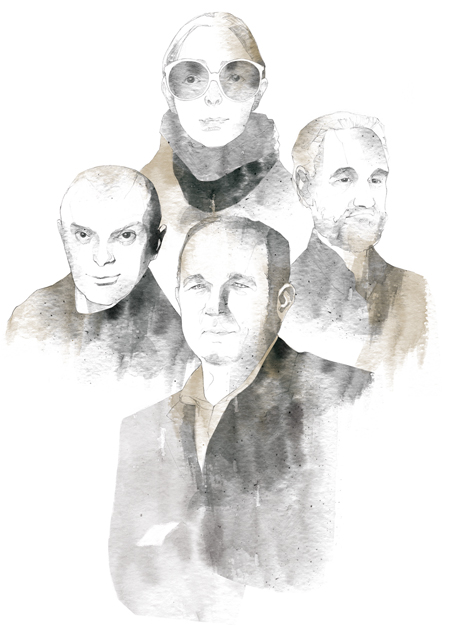
Corriere della Sera’s latest issue of Casamica, Quale Design, was out just in time for Salone del Mobile. As usual, the comfy and of-the-moment magazine features excellent reading: there are features on Enzo Mari, Andrea Branzi, Faye Toogood, and Cappelini. There’s a look at the furniture branches of some of the big fashion houses – from Hermès to Margiela – and a look at that ever-divisive, über-iconic cross, through design eyes. 2DM’s Marco Klefish once again pops up throughout the issue, with hand-drawn portraits of the maker-shakers whose works are featured.

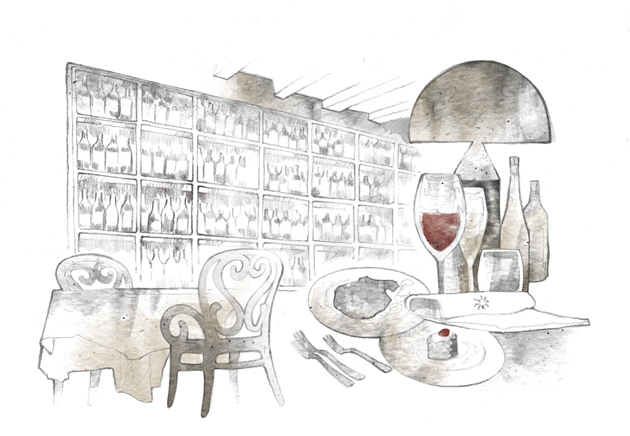
Karin Kellner, 2DM’s master of texture, made her debut in the magazine with a series of feature illustrations. For a roundtable discussion called “Design per il futuro,” she illustrated Rossana Orlandi, Denis Santachiara, Alessandro Vecchiato, and Carlo Urbinati. She also did a two ambient interior illustrations, one for a short article on the restaurant Gran San Bernardo. Karin, herself was once a student of design, and had a great time drawing the portraits, calling it a great way to “breathe creativity.”

“I love to capture expressions in watercolour… emphasising light and shadow,” said Karin. We’re thrilled with her work and can’t wait to see the next issue.

Tag Christof