29/05/2012

Found Muji

Found Muji

Muji is a worldwide known brand famous for denying having a brand identity at all. Or at least, hiding it. The power of the un-branded, almost thirty-year-old company has always been the strong focus on the product quality. The quality pairs with extreme simplicity, a ‘supernormal’ quality – as Naoto Fukasawa, a company associate, and Jasper Morrison would put it. 
The designs Muji has put on the market have never been publicized by its famous designers’ names, although the company wouldn’t have hard time showing off, seeing the impressive list of its collaborations.
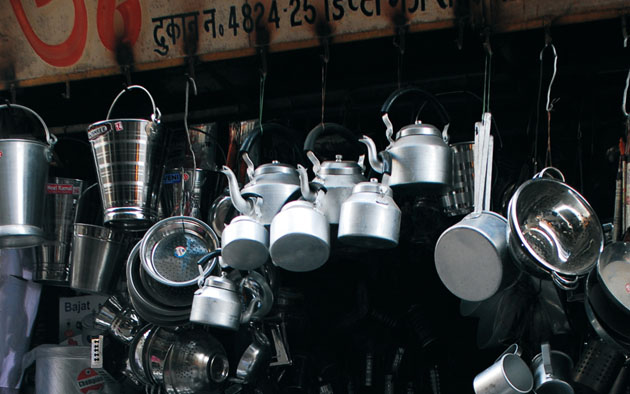
Among the designers working with Muji, you can read names like Konstantin Grcic, Enzo Mari and the two design superheroes mentioned above. These pop-stars of design have conceived some of the simplest objects of our everyday use such as an umbrella or a mug. Not quite a posh assignment for this elite of creative engineers.
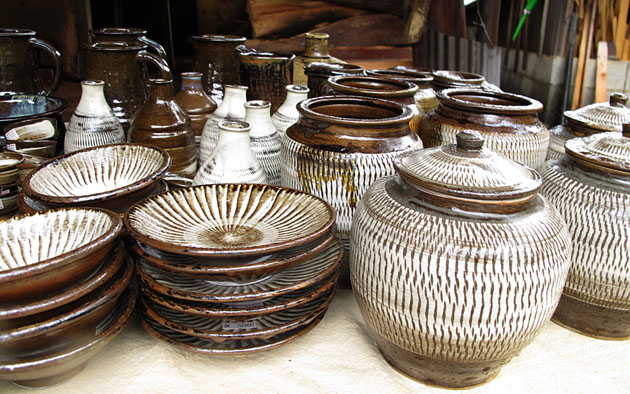
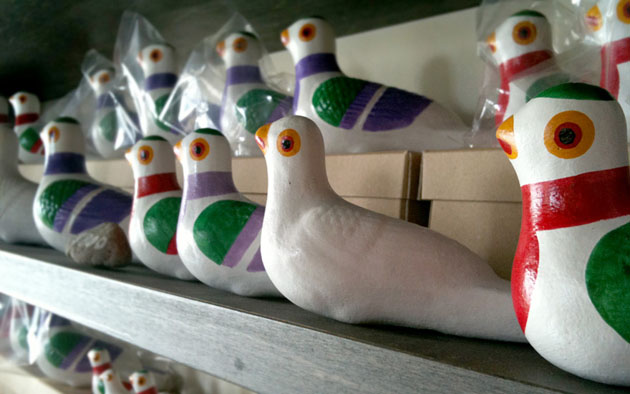
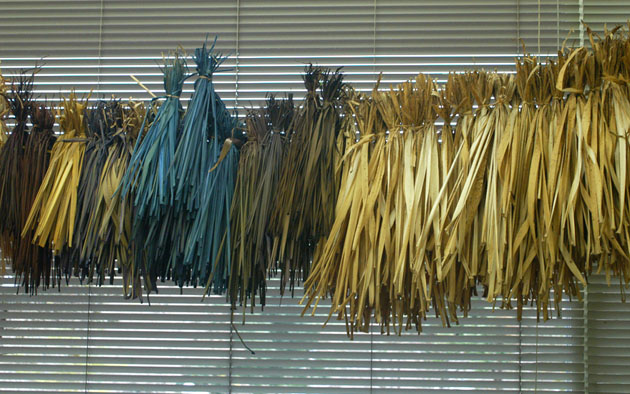
As we may argue endlessly about how this un-branded strategy has actually created one of the most powerful contemporary brands, Muji has moved forward to developing a new project. Muji has taken the role of the collector and the distributor of some of the finest local crafts, thus promoting a kind of design heritage handed down to us from the tradition of our popular culture. 
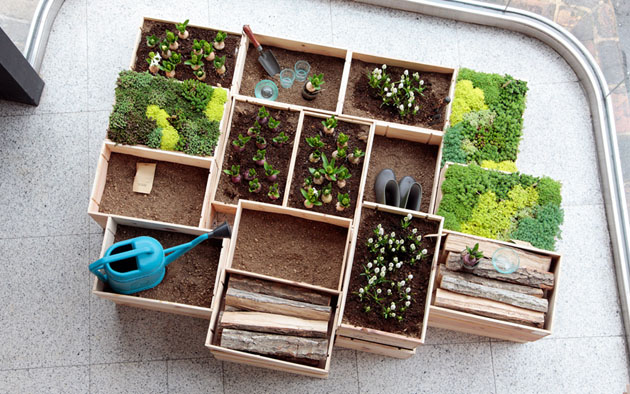
The found collection comprises a series of jugs, brooms, toys, ceramic sculptures and gardening kits among others, all so essential and well conceived that they might have actually been designed by some of the Muji’s creatives. The utmost proof of the importance this concept represents for the no-brand company is the opening of the Found shop at the first ever Muji Tokyo store in Aoyama.
Rujana Rebernjak – Images Muji

28/05/2012

Copperwheat -Punk, Prints & Potential

.

Copperwheat -Punk, Prints & Potential

There are a lot of facts one could find interesting when talking about the London-born and New York-based Copperwheat cousins, Ben and Lee. Lee has been teaching at Central Saint Martins and Royal College of Art, he is the Copperwheat of the Copperwheat Blundell label, and his freelance list of work includes names such as Marc Jacobs, Stephen Burrows and Coach.

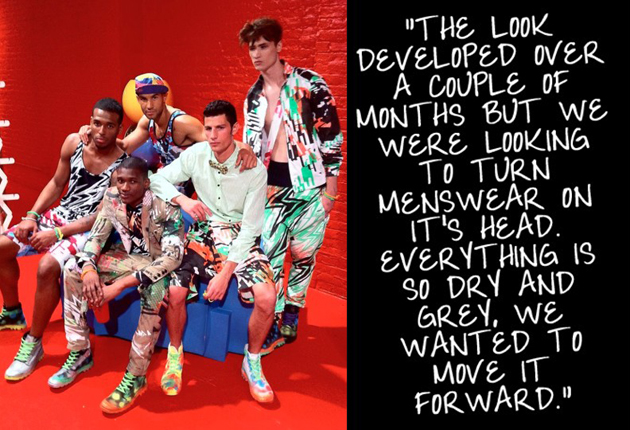
Ben has a Master’s Degree in Printed Textiles and a position as Senior Print Designer at Calvin Klein Jeans on his resume, and his portfolio holds work for Isabella Blow, Gucci, 3.1 Philip Lim and Tommy Hilfiger, among others. What is of more interest is their joint talents and effort put into the eponymous label Copperwheat that they established in 2009, aiming to bring a fresh angle into menswear.

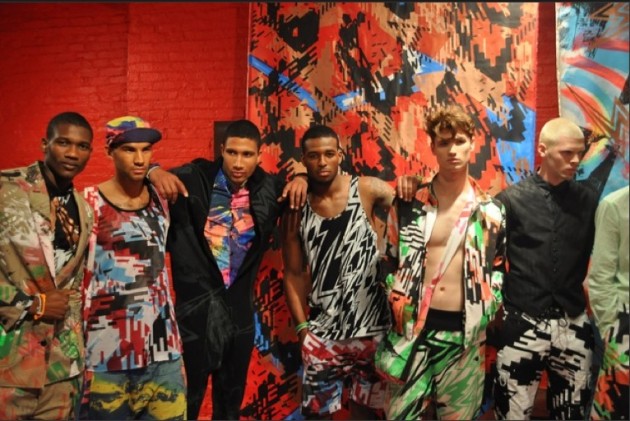
“London To New York”, the debut collection for S/S10, laid down the ‘frames’ for the upcoming seasons of bold colours and prints, and even though there has been a shifting level of vivacity in the subsequent collections, the strong aesthetics and image are continuously coherent. After a, in comparison, rather somber F/W11 collection, Ben and Lee went back to the vibrant and eccentric and presented “Smash It Up!”. The S/S12 collection surpassed their previous work and took the brand’s pulsating prints and colours to a new level of interesting; a slight hint of 80’s punk references and a mash-up of everything you could expect from a brand like Copperwheat.

The last season has been cheerful for the brand and some of the attention is the outcome of the collaboration with Cappellini. Both the S/S12 presentation and the Fashion Night Out event – which ended up on Vogue’s Top Ten list over FNO happenings – were held in the Cappellini SoHo store, emphasizing the brand profile of Copperwheat. Menswear is not changing as rapidly as the women’s fashion, but with a lot of potential on the market, a brand bold enough to keep it interesting both through the actual clothes and also through what happens around the brand, might be able to add something to the evolution.

Lisa Olsson Hjerpe – Image courtesy of Copperwheat

27/05/2012

Sunday Breakfast by Love For Breakfast

Sunday Breakfast by Love For Breakfast

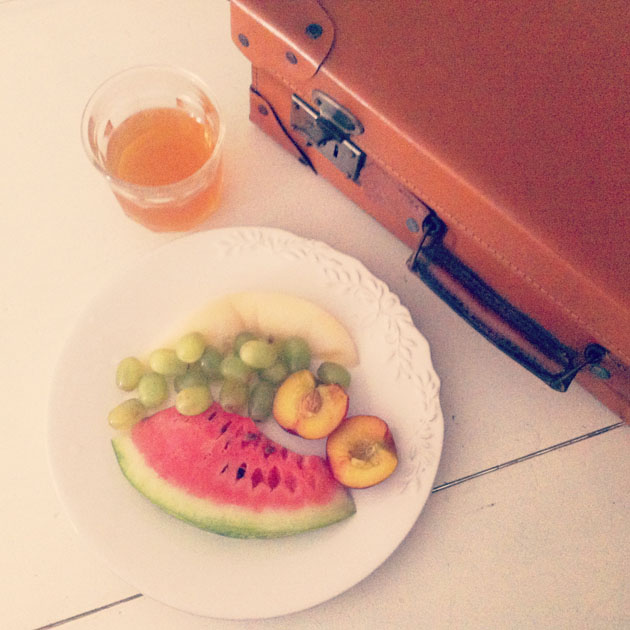
Wake up early and just one thought, escape from the city. The first glimpse of a day that taste of new is a dish made of fresh fruits.

Alessia Bossi from Love For Breakfast

25/05/2012

Mind the Map

Mind the Map

Everybody knows Harry Beck’s map of the London Underground system: brightly coloured lines running only at right and acute angles, connected by circles and notated neatly in the signature Johnston typeface. It is arguably the most beautiful, influential and important piece of information design ever. Its magic lies in its ability to render an incredibly complex system eminently comprehensible through abstraction and good design: while it is geographically inaccurate, you simply can’t lose yourself in it. For decades, cities the world over have tried to ape its intuitive simplicity and iconic handsomeness to no avail.

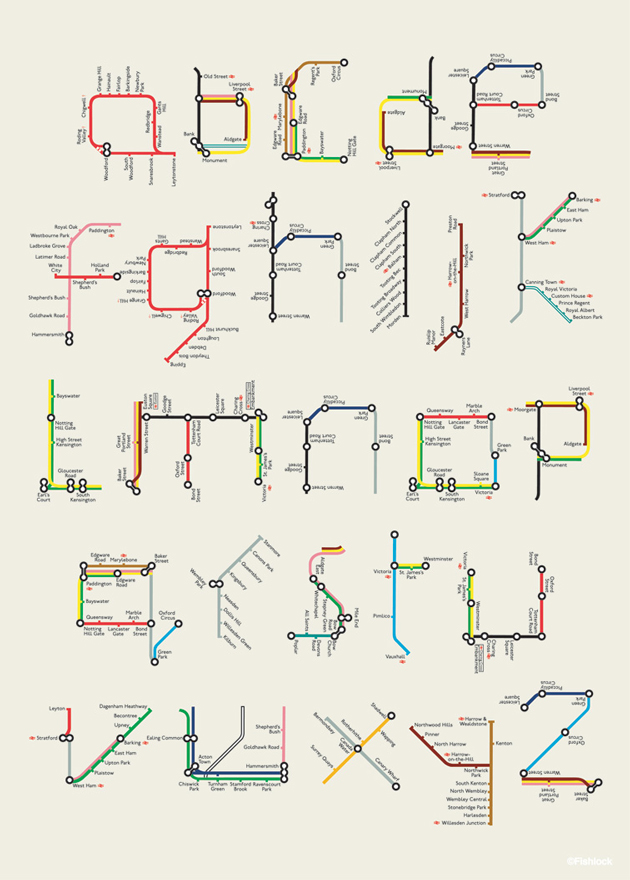
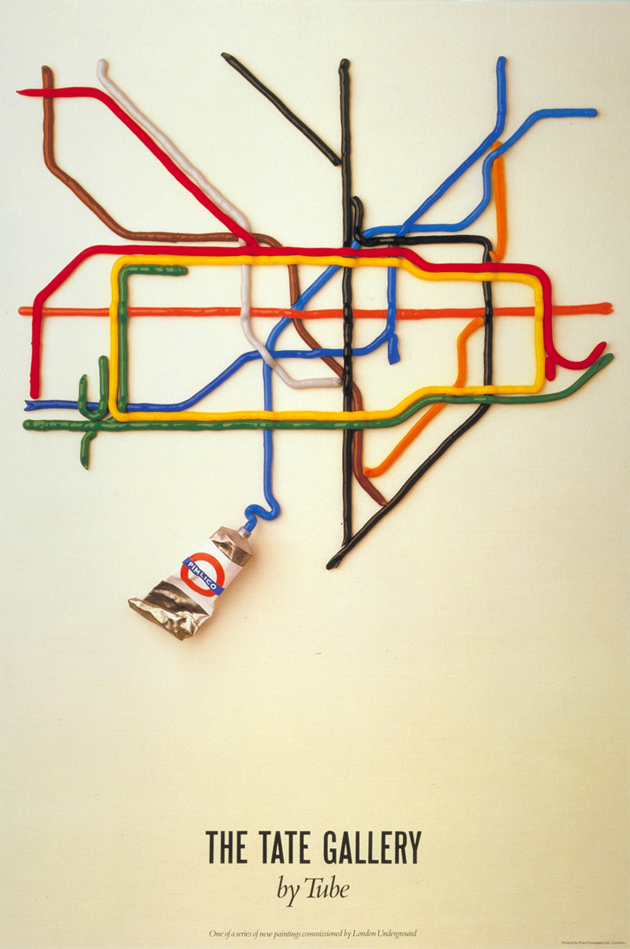
In the spirit of Beck’s design, the London Transport Museum this week launched Mind The Map, an exhibition of iconic and newly commissioned artworks inspired by the map itself. Included in the exhibition are abstractions, deconstructions and reconstructions, including David Booth’s legendary paint tube map for Tate Britain and Tim Fishlock’s “A-Z” alphabet made from the hidden letterforms to be found in the map’s many sinewy intricacies.The exhibition’s ethos is “the maps in this exhibition are more about journeys than geography,” and nowhere was this more clear than in Jeremy Wood ethereal “My Ghost” maps, in which the artist used GPS to track himself around London to reveal his phantom presence around the city.

Catch Mind The Map tucked in behind the museum’s usual interactive collection of TFL history – 19th century train cars you can sit inside, classic Routemaster buses you can climb aboard and life-size models of 19th century subterranean tunnelling – running through October 28th at London Transport Museum’s space in Covent Garden.

Tag Christof

25/05/2012

Johanna Pihl – The New Rookie In Town

.

Johanna Pihl – The New Rookie In Town

Swedish designer Johanna Pihl is one of the 5 hopeful nominees for The Swedish Fashion Council’s Rookie Award 2012.

Since 2005, S.F.C has organized the competition in order to promote young talents in the Swedish fashion industry. “Passion for design, interesting concepts and promising brand value” are what the jury with H&M’s head designer Margareta van den Bosch in the lead are searching for, and winning the competition means heavy exposure, networking support and PR-activities en masse. The coronation will take place during Stockholm Fashion Week the 15th of August.

“Being nominated for The Rookie Awards feels amazing, since it gives you opportunity to meet people in the business. At the moment, I’m in the middle of the process of creating my S/S 13 collection, and when you have a recently established fashion brand it’s so important to get the word out”, Pihl acknowledges.

Stockholm-born Johanna Pihl has studied fashion design at London College of Fashion, worked for avant-gardist Ann-Sofie Back and had an exhibition at The Victoria and Albert museum. Last year, she won the Young Fashion Industry Award which gave her the chance to present her collection during Stockholm Fashion Week. Along with brands such as altewai.saome and Alice Fine, Pihl has been named ‘the future of Swedish fashion’.


“The people in the business have always been very kind and supportive, it makes you feel appreciated. The hardest part, which is also the most intriguing part is that there’s always so much to learn every single day, there’s always a new challenge to face, but the performance pressure forces me to break boundaries, which I think is very important in this business.”

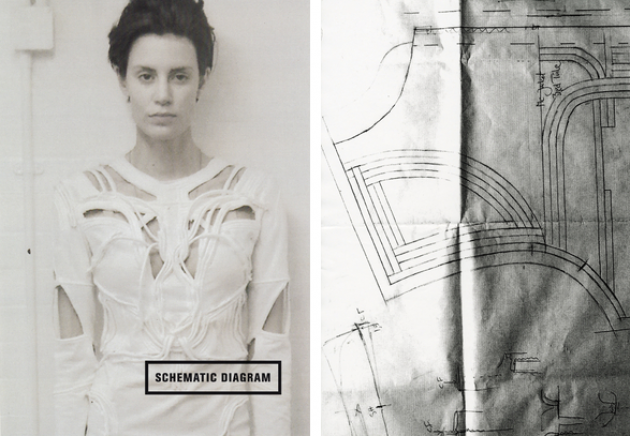
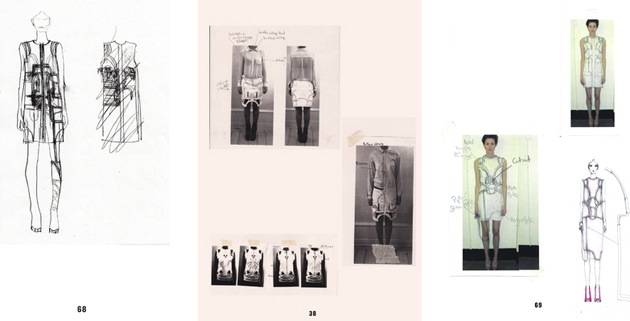
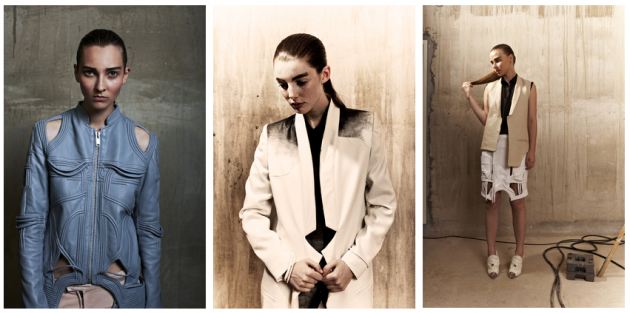
With her current collection, she introduces a contemporary tomboy-woman, with the most prominent piece being a cut-out leather jacket with detailing reminiscent of ancient day’s war breastplates. Behind every garments is a journey into the relationship between the anatomy of the body, and the ambivalent curiousness with body modification through plastic surgery. Sharp silhouettes, manipulated fabrics and high technical finish are three details to summarize Pihl’s design philosophy.

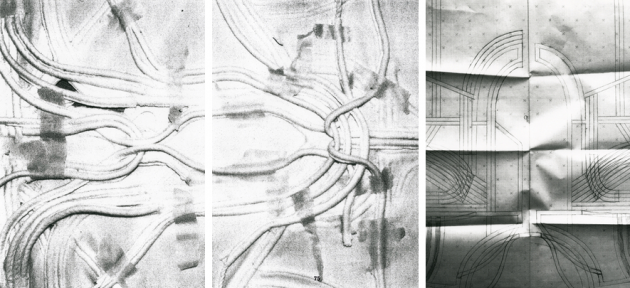
“The Collection is to be worn as a second skin. The garments represent our cast, stretched and distressed over our mechanical form. By using trapunto techniques the garments demonstrate that our anatomy is engineered and calculated like an engine, showing that by altering and reorganizing our appearance through plastic surgery we diminish our human design.”

Petsy von Köhler – Image courtesy of London College of Fashion, Patrick Lindblom, James Finnigan & Timothy Hill

24/05/2012

Retro – Recycling or Innovation?

.

Retro – Recycling or Innovation?

Retro and vintage are not unusual expressions when talking about design, fashion and style. The interest for the 20th century is an obvious reference and affecting point in the current fashion, as well as styles and outfits are copied right off through a mix of vintage clothing and retro trend pieces. While innovation, new thinking and uniqueness normally define fashion, it’s also a part of historic continuity where a constant progress also includes the revival of elements. Discussed from a historical angle, the reinterpretation of styles could be taken all the way back to when the Romans ‘reinvented’ the ancient Greek dress.


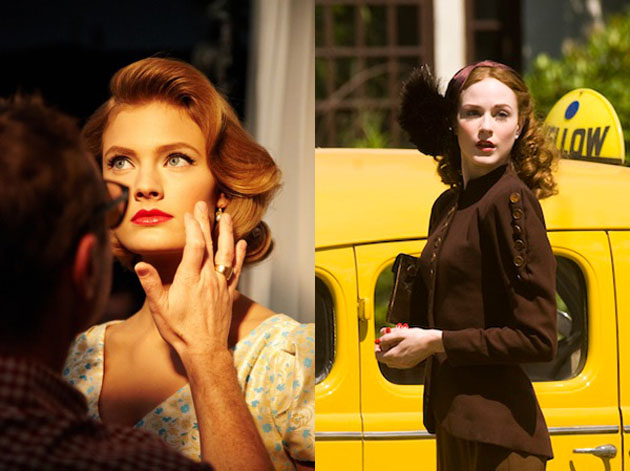
Lately the 30’s and the 60’s have been strong influencers in fashion. TV-series like Mad Men and Pan Am create nostalgia and somehow the decades are looked at as a ‘simpler time’, creating a window of escape for the audience. Even though not every woman will wear figure-hugging dresses and the men’s fashion might not become that much more slim, the inspiration is definitely noticeable.

The Röhsska Museet, the only museum dedicated solely for design and craftsmanship in Sweden, is hosting a vintage exhibition to specifically talk about how today’s trends are inspired by the 30’s and 60’s and how the era is affecting us. With a backdrop trailer from the film W.E. (about Wallis Simpson) the exhibition will together with fashion and interior design pieces also show exclusive vintage cars, borrowed to the museum from private collectors.

Even though both vintage clothing and the inspiration from the history are well accepted, the fashion industry is all about novelties. Some see retro trends as “old news by new designers” while others mean that ‘new’ should be seen as more than complete innovation. As a trend, retro is caught up in contemporary debates and becomes more than a static expression. Instead of looking at it as pure recycling, it might be the different ways of using ‘retro’ that become the innovation.

The Cars, Fashion and Design exhibition will be displayed at Röhsska Museum in Gothenburg, Sweden, between 26th of May and 9th of September 2012.

Lisa Olsson Hjerpe – Image courtesy of style.com

24/05/2012

Walking in the woods and unleashing ones thoughts

Walking in the woods and unleashing ones thoughts

Il faut cultiver notre Jardin
Voltaire

“We must cultivate our garden” concluded Candide – the character of Candide: or, The Optimism, one of the well known novel by Voltaire – condensing the idea of life of the French writer, historian and philosopher who rejects Leibniz’ mantra “all is for the best in the best of all possible worlds” in a very direct and sarcastic way. According to it, all human beings can do is to try to let their world become as good as possible and fulfilling it with their own experiences and values, independently from external influences.


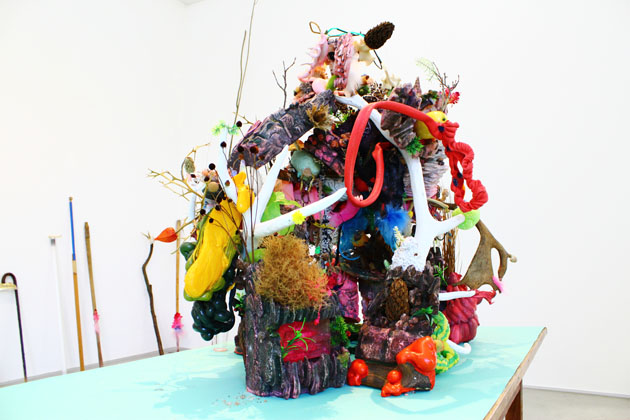
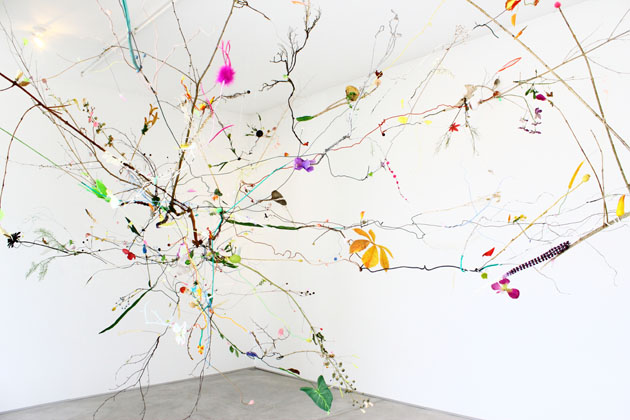
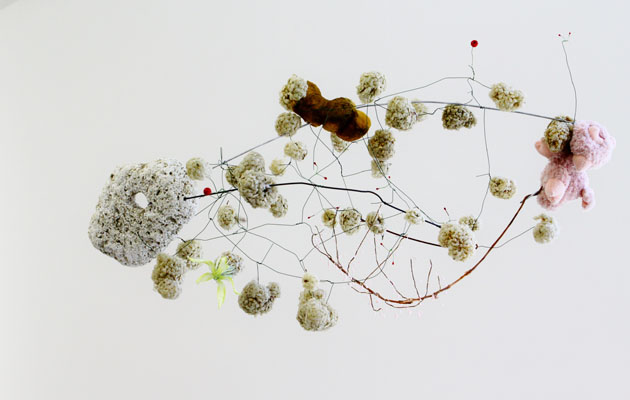
Exactly this sentence seems to frame the sense of Gerda Steiner (b. 1967) and Jörg Lenzlinger’s (b. 1967) art. Tangles of seeds, stems, branches along with animal bones, artificial plants, toys and unusual objects are picked up from different environments where the Swiss artist couple has lived. The objects inhabit their unique, imaginary and epistemological cosmos. With any apparent connection you find kitsch and worthless things: a toy robot, pieces of Chinese fountains, old stuffed animals or small plastic spiders. They coexist with biological and personal elements in a harmonic and poetic way.

The old bag of Jörg’s mother, hung on the ceiling in the middle of the library, contains a climbing plant which tends to the overhead lighting (Handtasche). A suspended twisted installation made of spawns, branches, plastic flowers and a pink teddy bear (Luftfisch) welcomes the visitors at the entrance of Buchmann Galerie in Lugano, Switzerland.

The whole venue is dipped in a flourishing garden full of artworks – Tony Cragg’s sculptures, works by Lawrence Carrol, Giuseppe Pentone, Felice Varini and Lawrence Weiner just to mention a few.

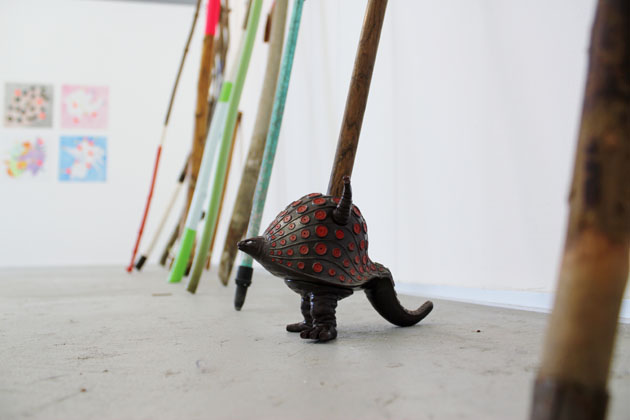
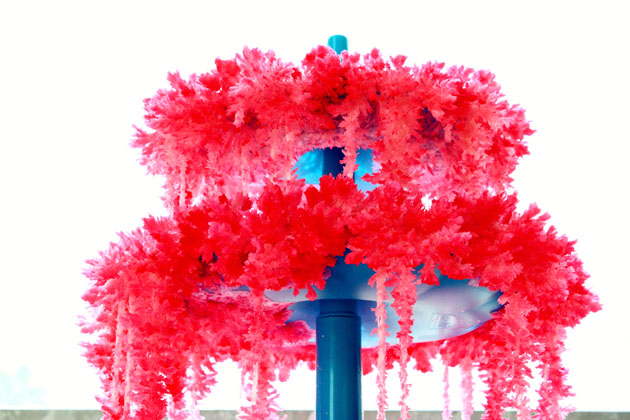
This amazing gallery building, a block of cement and glass, hosts also a collection of Steiner and Lenzlinger’s visionary walking sticks, a bizarre Chinese cave and a huge web, which embraces a room with its loaded tentacles. The artists, with their naïve and genuine allure, embody a sort of aesthetic of frugality full of content and able to intrigue viewers. It’s hard not to admire the brightly coloured organism (photo below) treated with a synthetically produced fertiliser that’s generally used in the agricultural industry, that grows fast as if it has been fed with the cakes of Alice in Wonderland (Isabel Friedli, Cultural Goods, text in the catalogue of the show).

The exhibition entitled Im Wald spazieren gehen und die Gedanken von der Leine lassen (“To go for a walk in the woods and unleash ones thoughts”) is a perfect merger of experimentation and research of an original language hovered between science and imagination both joyful and unsettling.

The solo show by Gerda Steiner and Jörg Lenzlinger will run until July 2012, open by appointment.

Monica Lombardi – Images courtesy Buchmann Galerie 

23/05/2012

Dual Colours – A Trend That Sticks

.

Dual Colours – A Trend That Sticks

Fashion forecasters say that a trend goes through three stages. Fringe, the phase where it’s novel, inventive and only the top trendy people or companies are taking part in it. When the trend then moves in to the stage of trendy, awareness is built and fashion-forward companies and retailers dare to enter the arena. Then comes the mainstream – the public join, the visibility of the trend increases and after a while in the spotlight, micro trends are born out of it; countertrends, backlashes, twists or reinventions.

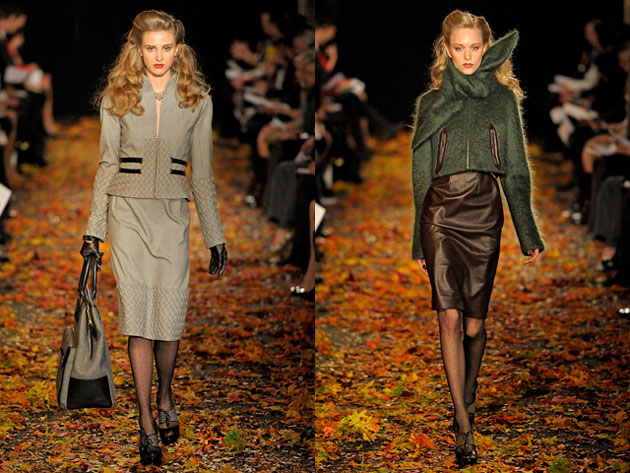
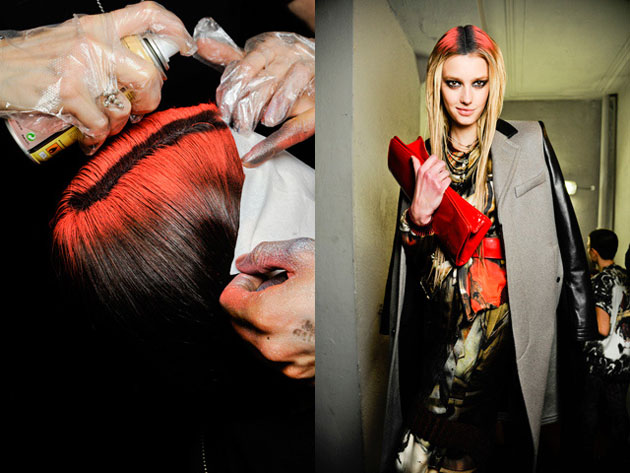
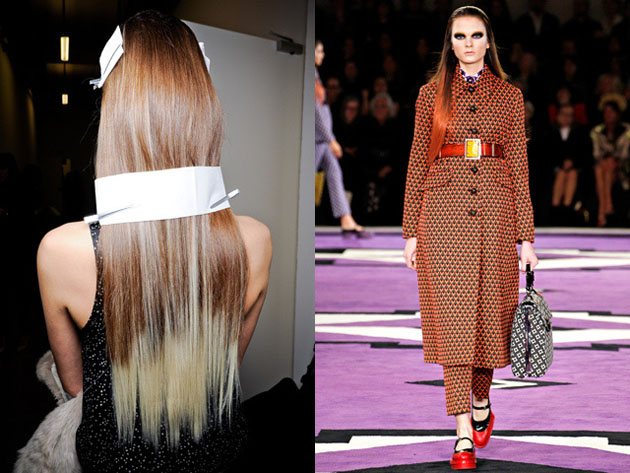
The two last mentioned are particularly true with the dual hair colour trend; dip-dying, bi-colouring, bleaching, washed out colours… It has been seen throughout the last seasons in various combinations, with the ombré trend (dark roots with light ends) being one of the larger ones to hit the mainstream. Colours come in cycles, and the repetitions in colour popularity and preferences are the machinery of boredom; the market gets tired, so new colours are introduced. It’s a phenomena that works the same in fashion as for hair colours. Just when you thought this bi-coloured trend was starting to get tired, large fashion houses like Prada and Jean Paul Gaultier brought it back to the catwalk for Fall/Winter 2012, with a twist.

The models walking the runway in Milan and Paris have been compared to virtual dolls being the ‘avatars of fashion’s digital age’. Leyla, a colour technician at Toni&Guy in Stockholm, confirms that the trend is taking a slightly more powerful and futuristic turn during fall.

“Absolutely! If you take a look at the Jean Paul Gaultier and Prada shows, you will see the same colour pallet but with a slightly different approach where Gaultier used colour spray in the roots, creating a quite powerful colour statement”. When asked why she thinks this particular trend keeps on reappearing the response was: “Because it works! The trend for hair colours is still that it shouldn’t look too ‘alone’ and this is a colour style that doesn’t get a re-growth. Also, it keeps on coming back in different modes. Last season it was more pink and yellow and at the moment it’s more red and blue. The techniques vary as well; now we’re using a lot of extensions and colour spray that washes right off”.

The fashion weeks in Milan and Paris showed that the trend is growing stronger and coming back for the fall, but it’s not withdrawing for summer either. The creative team at Toni&Guy writes in their trend report that one of the biggest trendsfor SS 2012 is the stretch roots and dip-dyed colours, taking us back to the 90’s and 70’s, before progressing into the fall trends. Summer earth tones will be replaced by less low-key colours like eccentric orange, cobalt blue and icy whites. When talking about the trend working both ways for men and women, Leyla explained us: “There are not that many men that can carry so many colours, but the ones who can; go all in! We will be playing with full bleach, silver tones”.

Fringe, trendy or mainstream, this style has been reinvented, swivelled around and gone through the evolution of a trend more than once. The runway inspiration allows the interpreter to play whole new vibrant colour game and it will be intriguing to see how far one tendency can take a whole trend.

Lisa Olsson Hjerpe – Image courtesy of style.com

22/05/2012

Kristina Gill: Italians Do It Better

Kristina Gill: Italians Do It Better

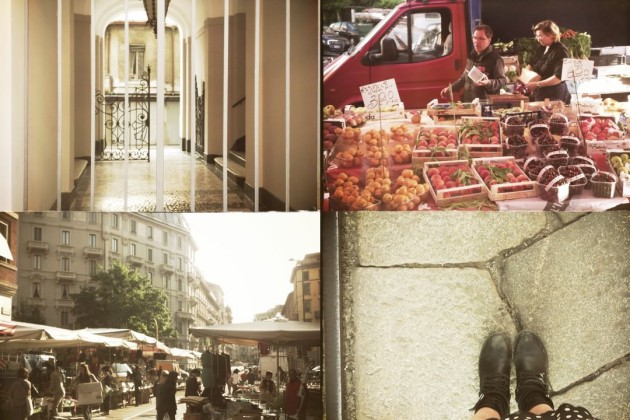
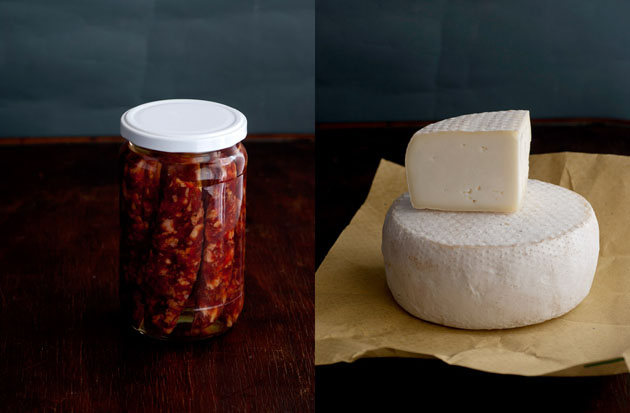
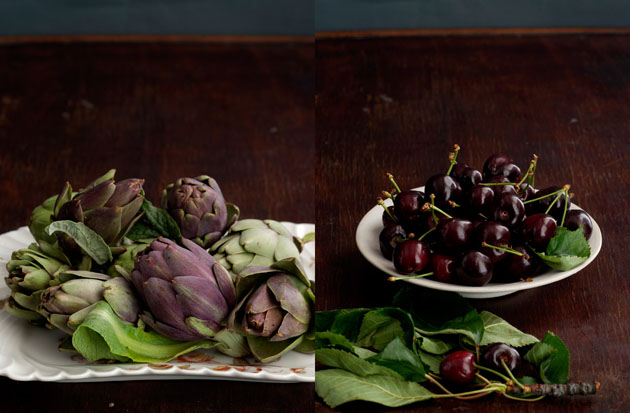
I’ve often asked myself why Italian food producers don’t get in to the attractive packaging and labels you see in other places, like Waitrose (UK) or Whole Foods (USA). It would take so little for them to conquer the world if only they made that one per cent effort, I think. But then I realize that Italians are right to think they don’t need any special packaging with a special typeface (no matter how simple) to help draw people in to their foods. Nature’s packaging is the simplest there is, and in Italy’s case, nature has rewarded Italy disproportionately with the conditions to grow exemplary almost anything. Having the best primary ingredients ensures that anything you make thereafter will be great.

I don’t condone the pervasive upturned nose at anything that isn’t Italian cuisine because there is a lot of good food in the world that isn’t Italian. But when you come home from a nearby farm or food market in Italy with local foods like these, can you really blame anyone for thinking Italians do it better?

Kristina Gill

22/05/2012

Solution Series

Solution Series

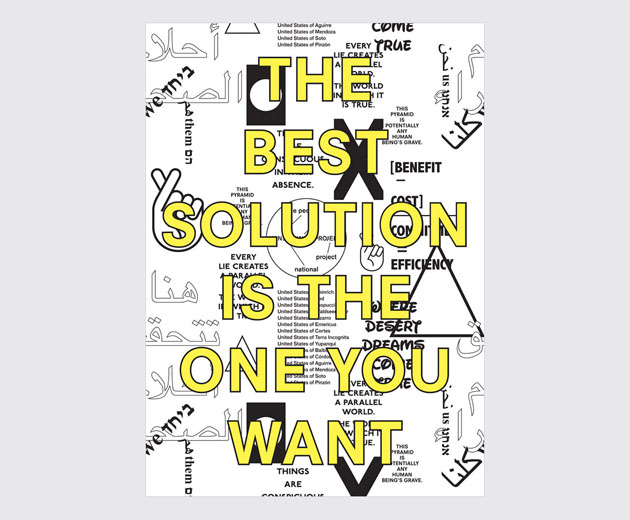
Even though graphic designers are keen on thinking that their profession makes a difference and that it’s politically, ethically and culturally relevant in our society, it’s a rather uncommon phenomena seeing this idealistic approach actually at work. Especially when it comes to Italy, graphic design is still considered an ‘artistic’ outtake on the artifacts we encounter on a daily basis. On the other hand, designers themselves generally profess a more politically active attitude but aren’t capable of actually putting it into practice.

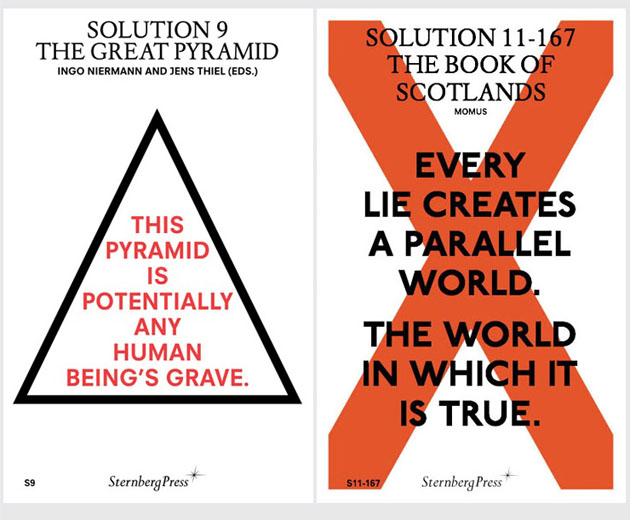
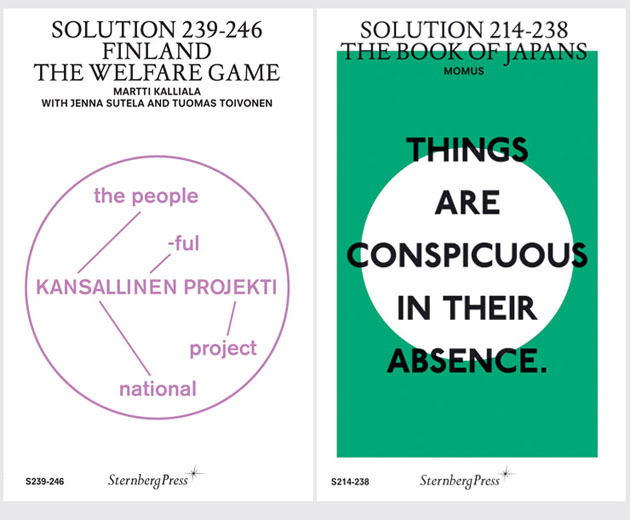
There are, however, a few practitioners that try to take the matter in their own hands. One of the projects that was born from this kind of approach is Solution Series – a series of books published by Sternberg Press and curated by Ingo Niermann with the precious contribution by Zak Kyes (a graphic designer we have already praised in one of our articles).

The Solution Series has quite a definite – and also a bit pretentious – ring to it. What it does is developing highly critical cultural proposals in a tumultuous era of geopolitical instability that should function as stimulus for rethinking some of the urgent problems present in the area the single book refers to. Some of the titles in the series are “Finland: The Welfare Game” by Martti Kalliala with Jenna Sutela and Tuomas Toivonen, “The Book of Japans” by musical artist and writer Momus, “United States of Palestine-Israel” by Joshua Simon, “America” by Tirdad Zolghadr and “The Great Pyramid” edited by Ingo Niermann and Jens Thiel.

Ironically by using the word ‘solutions’ the editor mocks the well-established critical discourse by ‘inviting the authors to develop an abundance of compact and original ideas for countries and regions contradicting the widely held assumption that after the end of socialism human advancement is only possible technologicaly’.

The latest outtake related to the project is “Solution Greece?”, an exhibition of the work developed by Kyes for the Solution Series. Hosted by Ommu, a bookshop and project space situated in Athens, the exhibition tries to demonstrate the power of cultural production and the kind of solution it might offer in a country that is coping with a difficult political and economic crisis. Finally a socially and politically relevant, even though slightly utopian, approach of contemporary graphic design practice towards the problems of our society.

Rujana Rebernjak – Images courtesy of Sternberg Press