07/06/2011

The Book Affair / Automatic Books

.

The Book Affair / Automatic Books

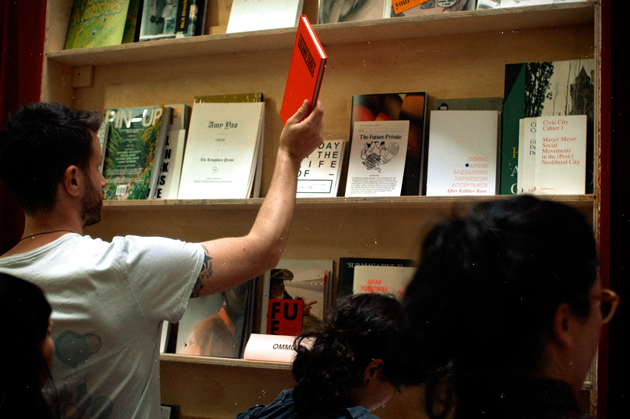
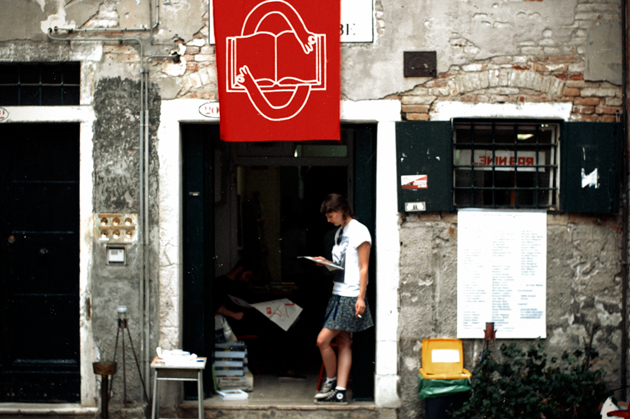
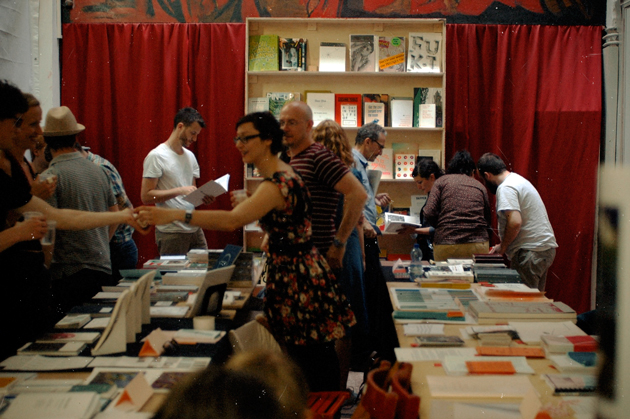
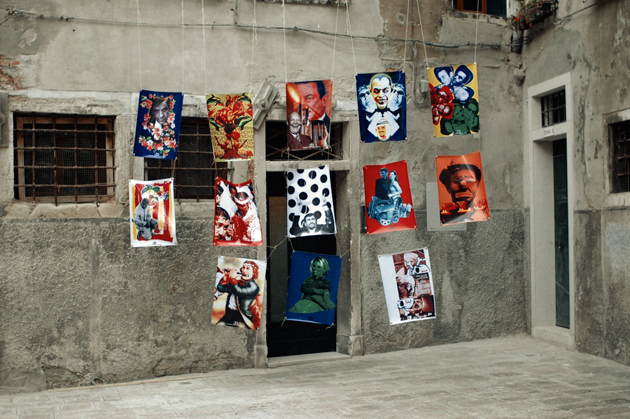
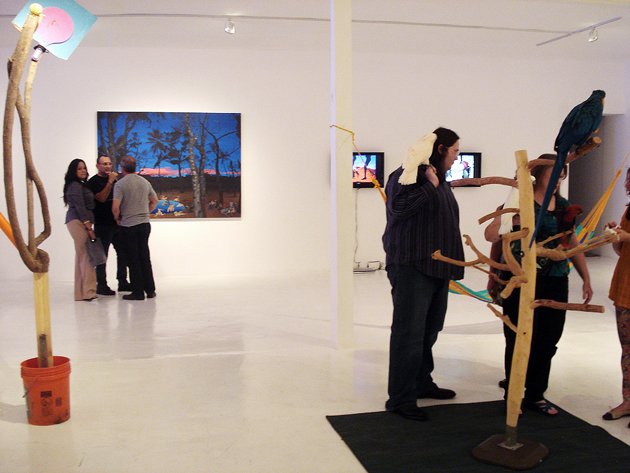
Last Thursday and Friday Metricubi played host to The Book Affair. Tucked into a cozy corner of Campo San Polo under ruby red Elena Xausa-designed banners, the event curated by Automatic Books brought together an excellent cross-section of independent publishers working across Europe today.


And although the polizia showed up at one point (down, rowdy book nerds!), the event was a smashing success. There were a series of readings by the various publishing houses, and the entire event was set up to encourage conversation. Much like picking fresh fruit from an orchard, talking to the people who make the books you’re about to read is a revelation not to be missed.

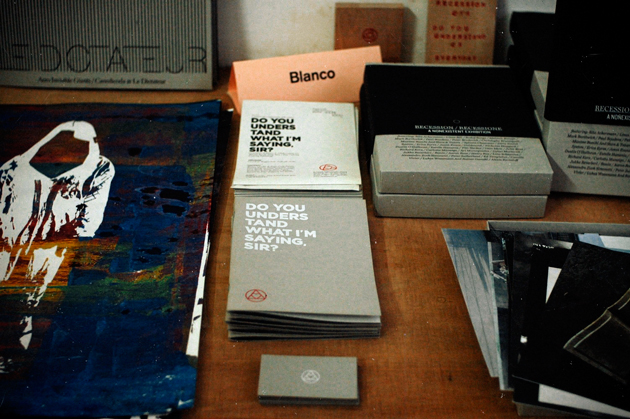
Highlights included the intriguing works by France’s Incertain Sens (including one of its entirely handwritten notebook volumes), a large selection of works from Britain’s Bookworks, the Recession boxed set by Studio Blanco, and some seriously deep literature pondering existence, banality, politics, everything… We were happy to see a printed version of San Rocco, having admired their website and the concept behind their zine for quite some time, and were exposed to a host of stellar works from foreign publishes we hadn’t known before. And we were happy to see works in the flesh by 0_100, Secret Furry Hole, Kaleidescope Press, The Milan Review, and Wonder Room alumni Studio Temp.

As top-down publishing increasingly gives way to electronic, hybrid and user-generated formats, the creativity these independent houses bring to books is a promising look towards the future. While run-of-the-mill, straightforward books might one day cease to be printed on paper, the book itself has exciting new life ahead of it: originality, distinction, rarity. Not only are these publishers not abandoning the printed, physical book, they are carrying it forward in its most fertile conceptual space – they are creating new, original paradigms and designs for end users who will continue to appreciate books as treasures.

The Book Affair’s first outing was a fantastic start, and we hope it flourishes with time. Until the next outing!

Tag Christof

07/06/2011

Yvette Van Boven / Winter & Zomer

.

Yvette Van Boven / Winter & Zomer

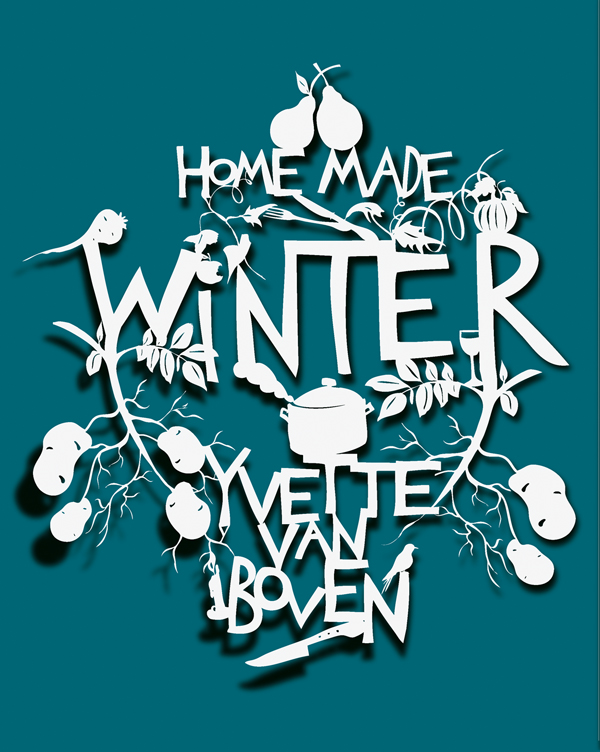
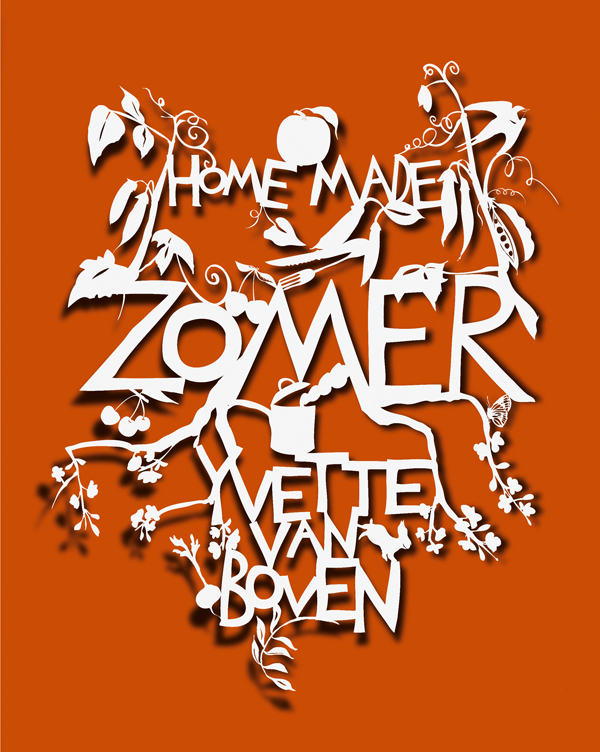
Can illustrations be delicious? Yvette Van Boven’s are. Her warm and approachable style is a reflection of her enormous passion for food – she co-owns an adorable restaurant in Amsterdam, Aan de Amstel, and her work has appeared in an enormous range of publications, from Grazia’s online edition to the cover of Wallpaper* and her delicious Sunday Brunch column on The Blogazine.

As a followup to her fan-favourite and critically acclaimed (2010 Dutch Cookbook Of The Year) “Home Made,” Yvette is releasing two seasonal additions to her canon: Winter and Zommer. So far, Yvette’s only released the covers to the world, but we can probably safely guess that they’ll be filled with lovely photography, a host of gorgeous handwritten recipes, illustrations and perhaps even a few of her lovely paper cutouts.

But just before Winter will hit bookstore shelves in October, Home Made will also be released in English (at last!) – pre order for its September 1 launch date! Zommer will be out spring 2012.

Facciamo un bis! Seconds, please!

Tag Christof

06/06/2011

The Editorial: This Is A Work Of Art. Why?

.

The Editorial: This Is A Work Of Art. Why?

“QUESTO È UN’OPERA D’ARTE.” “THIS IS A WORK OF ART.”

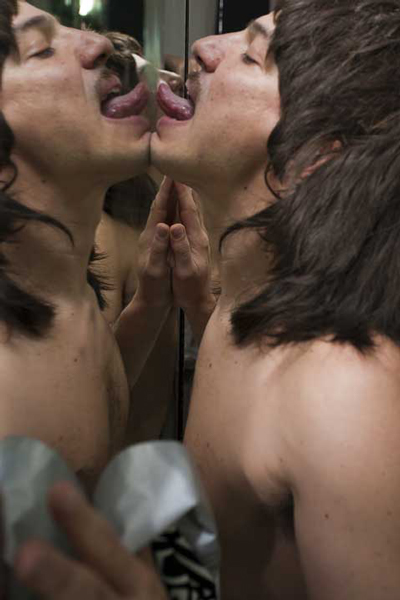
So says a blaring voiceover repeatedly as a small crowd gathers around two armchairs on wooden platforms designed by Gaetano Pesce. They appear to be straight out of Dr. Seuss, are highly derivative of his iconic 2010 “Senza Fine” line, and are occupied by two lounging nude models – a very busty blonde woman, and a muscular, long-haired man. Gaetano himself is there, mingling with the people who have gathered around mostly to catch a glimpse of the nudes, and perhaps to shake the hand of the celebrity designer who produced the pieces. But wait. “THIS IS A WORK OF ART,” the voice reassures us again. We’re not so sure…

As part of Italy’s pavilion at this year’s Biennale d’Arte di Venezia, Pesce’s contribution was among the included works of several hundred others in the canon of contemporary Italian art. The pavilion is supposed to be a celebration of Italian art at the country’s 150th anniversary of unity, but it is mostly just a confusing mess. Now, nobody should fault the noble attempt to include the entire scope of art of a massive and diverse country like Italy. But many works of dubious quality were included, and each being in the context of so many others ensures that the importance of all of them is lost.

Some are claiming that what I’m calling a mess is instead an appropriate representation of the difficulty of Italy itself. The Franco-Italian critic Philippe Daverio had this to say:

“They are all together, gorgeous and ugly, in a populist and transversal exhibition. A community where everyone is a happy, participating member of the family… It is an exhibition which helps us understand how one makes inroads in Italy, and for this, the pavilion is the most anthropologically appropriate that I’ve ever seen in my life.”

Perhaps. But Curation 101 dictates that a common thread – more elegantly a filo conduttore in Italian – is essential to any good exhibition. And when seen in the context of the American, Danish, Russian and several other strong pavilions this year, Italy’s misses the point entirely and is more likely representative of the lack of a clear idea for what Italian art should be. If this exhibition’s common thread is none other than “a bunch Italian of artists,” it says nothing.

Art itself has gone through quite a tumultuous period over the past several years. With infinitely easier access to images, art texts and art culture, it seems like everyone is calling everything art. The proliferation of e-art and the word “art” and vague ideas of flamboyancy as art appearing even in the most mainstream of pop culture, everyone is now “into art.” The problem is, pop culture is by definition superficial and transitory. Art cannot be – yes, pop art is art, but art is not pop.


The Italian pavilion – and the inclusion of a piece of design by Pesce, an easily recognisable name the curators believed might lend credibility to their show – is surefire proof that we are rapidly losing sight of the pivotal and important roles art plays. We frequently allow quantity to win out over quality and for art to be confused with several other things. In the case of Pesce and his work, we elevate a random piece of design to the exalted status of art. Why?

Design may sometimes do the same things as art, but its primary goal is practical. Design is none other than the improvement or changing or re-shaping if the environment with which we interact – aesthetics play a role, but only insofar as they affect experience. Design must change behaviour and enhance lives.

Art must change minds. Art must beg questions. Provoke. Challenge. It can be wholly impractical. It must provoke thought and discourse. Impractical, whimsical design is not art. It’s probably just bad design.

With that in mind, we have nothing against Pesce as a designer. His design work has been influential and imaginative. And his recent and very powerful installation for the Triennale “L’Italia in Croce” (“Italy Crucified”) was strong sociopolitical critique and a symbolic lament for a country he clearly loves – that was much closer to art. But with some odd-looking armchairs that are heavily related to pieces he’s already commercialised, he most certainly can’t accomplish both. Like the designer he is, while he mingled with the crowd, Pesce talked up the materials the chairs are made of – not the statement they make nor the significance of the piece itself. Despite what the voiceover said, they are not works of art.

Tag Christof

01/06/2011

Pratchaya Phinthong / Give More Than You Take

.

Pratchaya Phinthong / Give More Than You Take

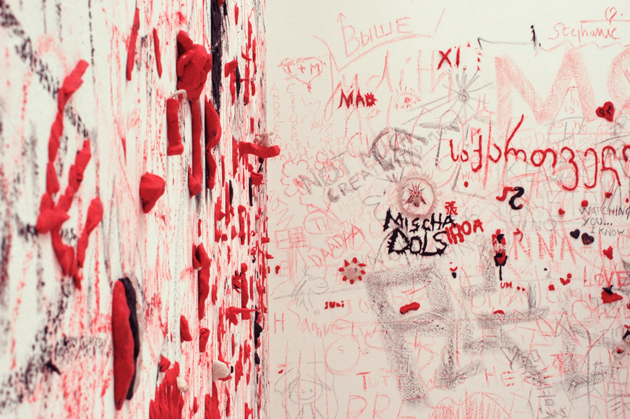
From May 27 to July 24 GAMeC, Galleria d’arte moderna e contemporanea in Bergamo – in co-production with CAC, Centre d’Art Contemporain in Brétigny-sur-Orge – is hosting the solo show ‘Give more than you take’ by Thai artist Pratchaya Phinthong.

The exhibition is curated by CAC Director Pierre Bal-Blanc, and Alessandro Rabottini, Chief-Curator at GAMeC, and is part of the museum exhibition program Eldorado, which aims at inviting international emerging artists to think about site-specific project.

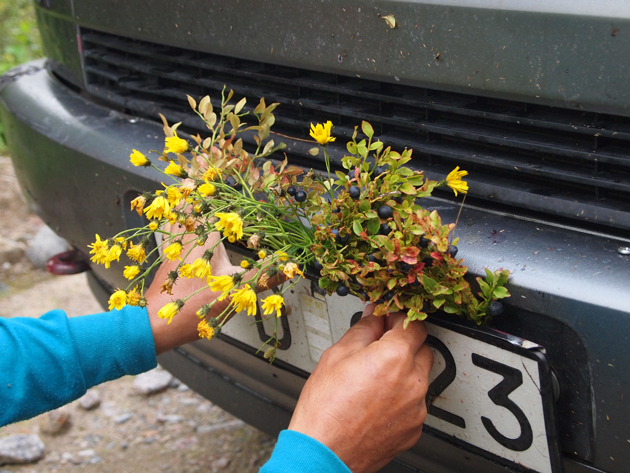
In 2010, Phinthong was invited to attend a two-month residency program at CAC Brétigny. Instead of going to Paris, the artist proposed Pierre Bal-Blanc to go to Swedish Lapland – recruited by a firm specialisin in exporting workforce for the seasonal harvest – to pick polar berries. This way Phinthong could live with Thai laborers, renouncing the status of artist, and see both the terrible conditions of the workers and the absence of rights that brought them to protest against unrestrained capitalism. At the end of each day the artist, through SMS correspondence, updated the CAC Director about the amount of berries he picked, and asked him to collect the same quantity of useless objects and garbage.

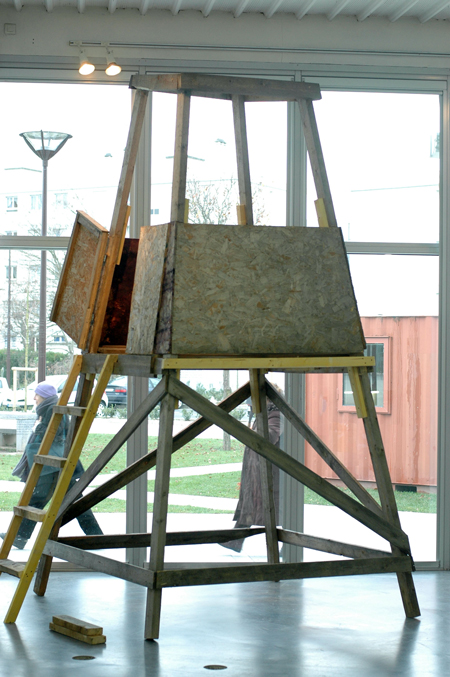
During the picking season, Phinthong, with the help of the workers, knocked down a shooting tower in the forest and sent the pieces to Pierre Bal-Blanc to be reassembled according to his personal point of view – Bal-Blanc opted for rebuilding and displaying it at CAC.

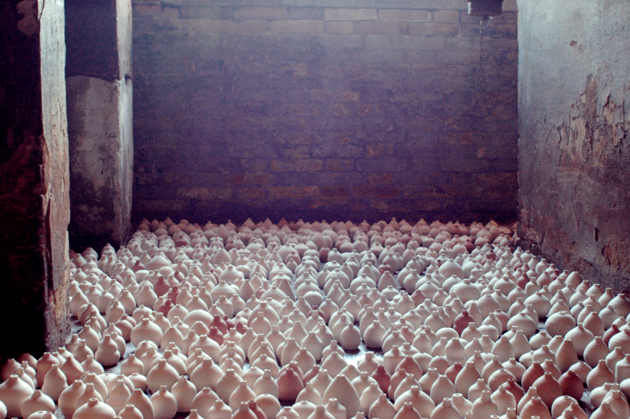
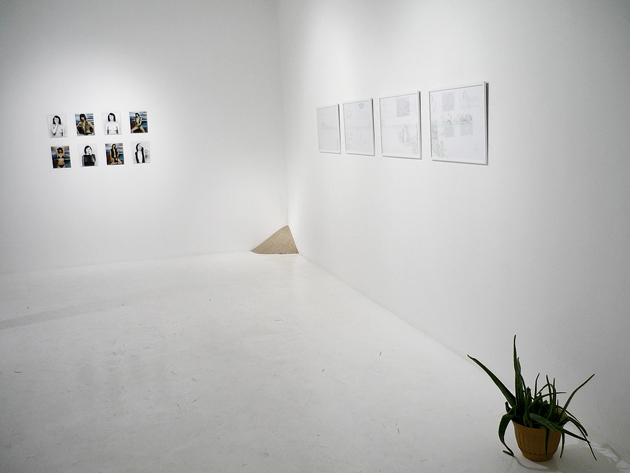
The tower is now presented in Bergamo as a monolith, a mass of wooden boards hung on the ceiling at its original height. Alessandro Rabottini, who joined the dialogue between the artist and Bal-Blanc bringing the exhibition in GAMeC, decided the entire arrangement of the collected objects – the wooden boards and the 549 kilos of earth dug close to the GAMeC – and, to reinforce his participation in the dialogue, he choose to handwrite the SMS in on the wall of the Museum.

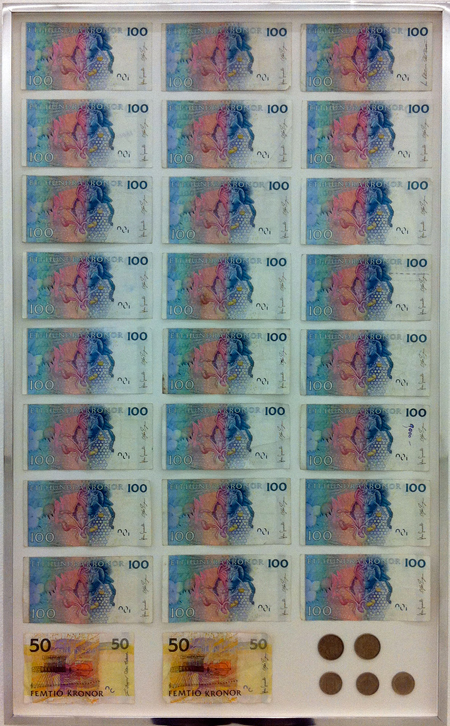
Among the works that complete the show: a case containing the amount of money gained by the artist working as a polar berry picker (283€); a website www.givemorethanyoutake.net, which collects images and videos recorded by Phinthong during his experience in Swedish Lapland and two oil paintings, made by a Thai artist, which can be sold separately but need a previous agreement among the buyers as they should be displayed in other exhibitions only together.

‘Give more than you take’ is a project based on the importance of exchange among human beings. The transfer of tasks between the artist, who loses his role, and the curator, who takes the responsibility of presenting the objects to the visitors, changes the value and meaning of the artworks, following the idea that social progress is strictly connected with giving, receiving and returning.

Pratchaya Phinthong (1974, lives and works in Bangkok) has exhibited his oeuvre at international institutions such as the Kunsthalle Basel, the Musée D’art Contemporain in Lyon, the University Gallery in Bangkok, the Artists Space in New York and RedCat in Los Angeles. He has also participated in the Biennials of Singapore, Taipei and Busan.

The exhibition will run until July 24 at GAMeC, Via San Tomaso 53, Bergamo.

Monica Lombardi – Photos courtesy Pratchaya Phinthong & CAC

01/06/2011

Essen: Tonno Sardo / Sardinian Tuna

.

Essen: Tonno Sardo / Sardinian Tuna

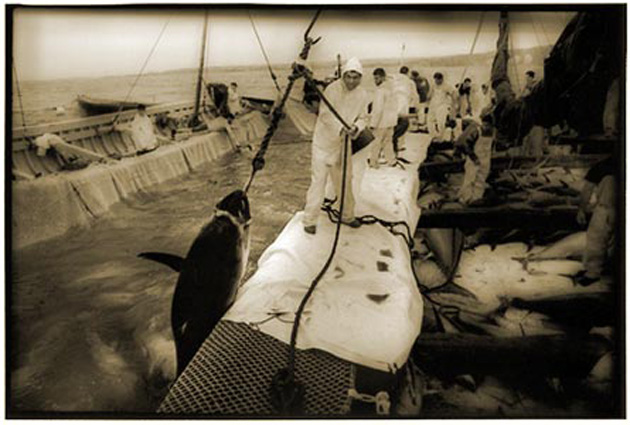
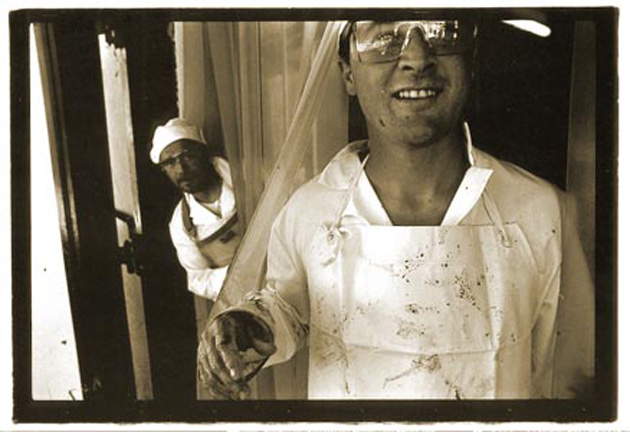
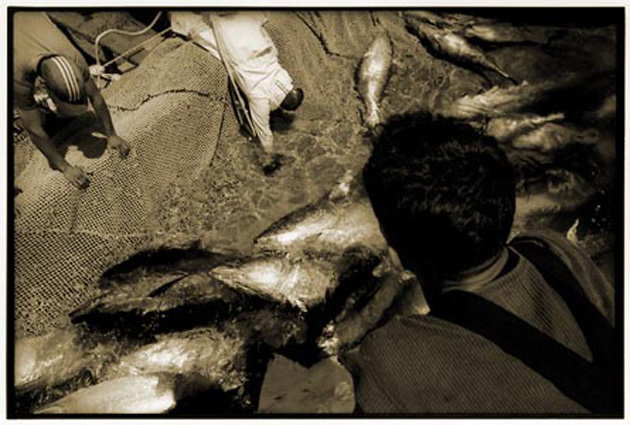
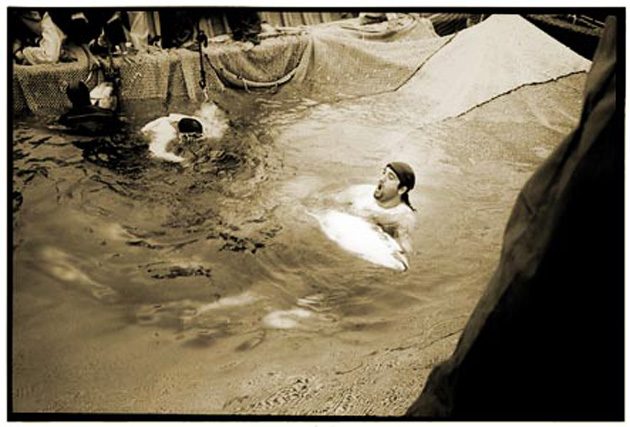
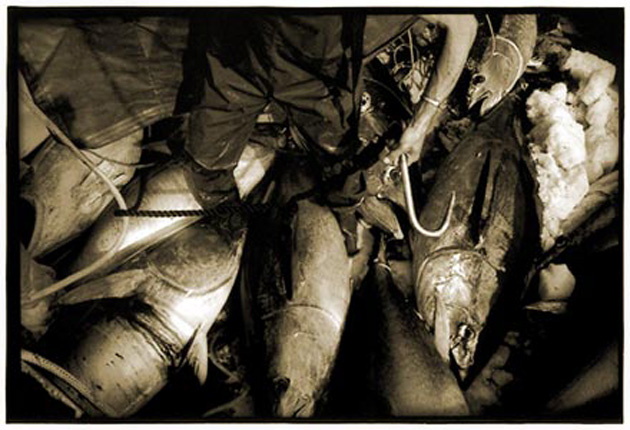
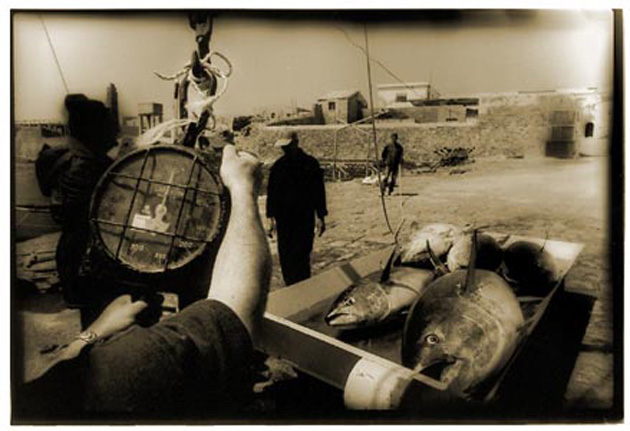
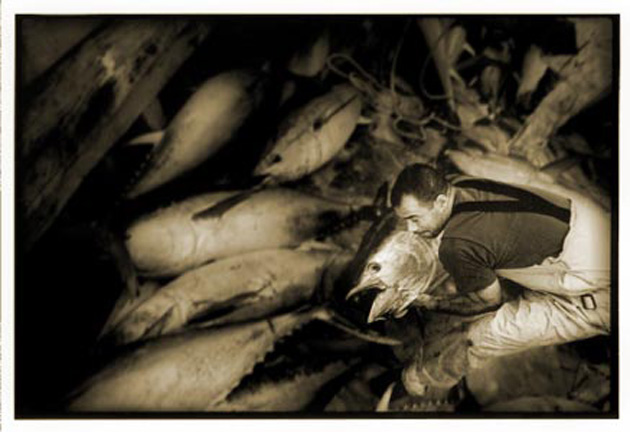
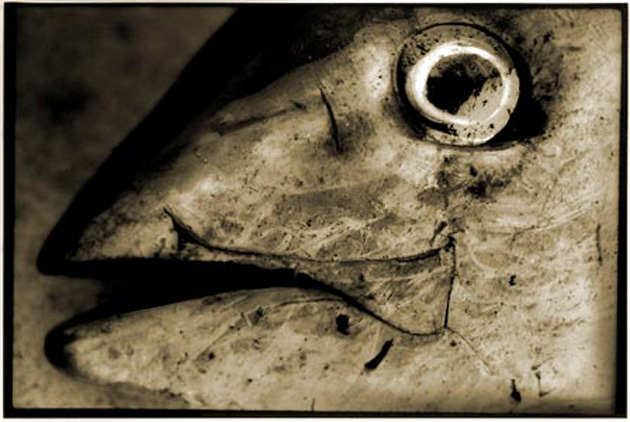
This week, we join photographer Vittore Buzzi on the tiny island of San Pietro off the coast of Sardinia. Here in this city, Carloforte – where you’re just as likely to hear Ligurian as Italian among the citizenry – Vittore captured scenes of a bustling fish market where hauls of some of the world’s finest tuna are brought in, and where fisherman still operate like they did generations ago.


This particular series of photos is special. They were shot in film and developed and handprinted by Giancarlo Vaiarelli on Forte fibre paper using an atypical process typically reserved for graphics. A graphic plate and cross-processing makes for an otherworldly effect – warm, evocative, distant – and timeless, with a sienna tone that evokes Sardinia.

Essen takes us up the western Sardinian coast to Alghero for our food feature of the week:

In the extreme heterogenity of the island of Sardinia, Alghero has lately charged itself with uniqueness. An enclave for the of the seafaring republic of Barcelona for centuries, it was for very long linked more closely to Spain than to the Italian “continent.” Clearly, this cultural and political exposure couldn’t help but leave traces in the local gastronomy.


Characterised by fresh, simple food that tends to revolve heavily around fish, algherese dishes mix the fruit of Sardinia’s crystal blue sea with a few leitmotifs of Spanish cuisine, like Paella Algherese.

Although the city’s signature dish is lobster, a much more simple fish – yet every bit as versatile – is notably important: the tuna. Here we’re sharing a simple, flavourful recipe that is quick and easy to prepare, and that in its simplicity brings all the flavours of Alghero to the table.

Tonno all’Algherese (Algherese Tuna)
Feeds 4

Ingredients:
1kg fresh tuna filets
3 glasses of Torbato D’Alghero (Doc) (May be substituted for an airy, dry white)
4 tablespoons of extra virgin olive oil
30 grams of pitted black olives
1 celery stick
1/2 white onion
1 lemon
2 bay leaves
salt

Submerge the tuna in water infused with the lemon, and let marinate for a at least a couple of hours. In the meantime, chop the onion, celery and bay leaves finely. Brown them in a terracotta saucepan – if you don’t have one, a non-stick pan will work fine.

When the greens have browned, add the fish to the pan and cook on slow heat for around 20 minutes making sure to brown it on both sides. Don’t use a fork and instead use wooden utensils. Halfway through cooking, add the white wine, allowing it to dissolve slowly over the tuna. Add the black olives, then salt. Cover the pan and finish cooling. Serve hot, laid out over its juices.


Photos Vittore Buzzi – Text & Recipe Cristina Zaga – Intro & Translation Tag Christof

01/06/2011

Icons: Dolce & Gabbana 1990-2010

.

Icons: Dolce & Gabbana 1990-2010

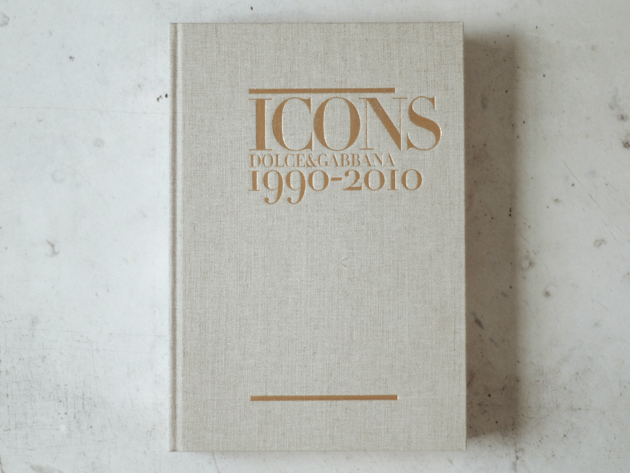
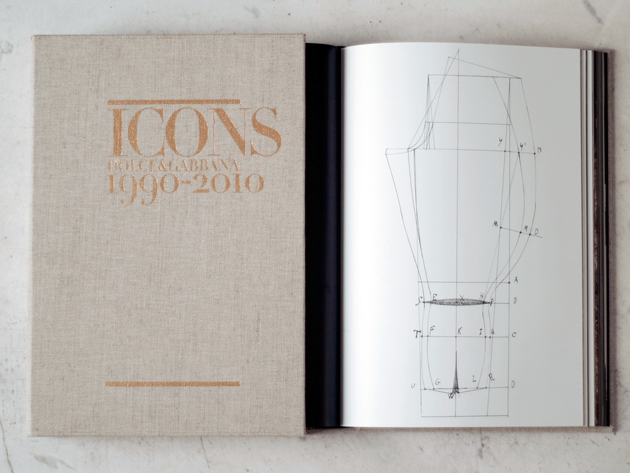
2DM was mentioned in Dolce & Gabbana’s lavish new monograph: 1990-2010. We received a couple of the massive, hardbound and fabric covered (and tastefully gold-accented) editions in the studio earlier this week.

The work, which is a panoramic view of their seminal men’s fashion work over the past two decades, is full of quotes from the indefatigable duo, sketches of the pieces that would eventually become “icons,” and hundreds of photographs (mostly black and white) from the industry’s very best photographers including our very own Roger Deckker.

From the Bureau

31/05/2011

Mayami Son Machín / Gallery Diet Miami

.

Mayami Son Machín / Gallery Diet Miami

Our guest bloggers Proyectos Ultravioleta talk about their exhibition “Mayami Son Machín” which runs until July 23rd at Gallery Diet in Miami.

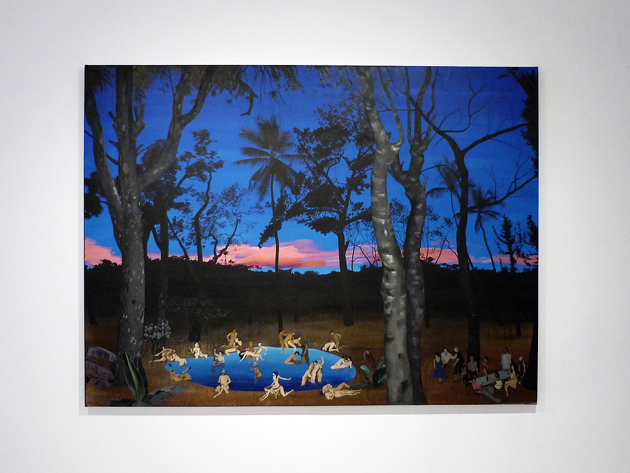
When Gallery Diet invited Proyectos Ultravioleta to do a show in Miami, a city we knew very little about (besides all that we Latin-Americans pretend to know about Miami, that is), our most reasonable option was to do a show about what we thought Miami was, regardless of whether it was true or not.

Neon colors were definitely involved, as were sex, music and a large dose of glamour, decadence, and humor. Partly because that is what a subcontinent believes Miami stands for, partly because that is what it wants the city to be. We broke the exhibition down into three parts: Mayami Son Machín. It is a a simple wordplay on “Miami Sound Machine,” the band that epitomized Miami in the 80s and 90s and was led by the mythical Gloria Estefan, herself an emblem of the complex relationship between Miami and Latin America.

I spoke to someone recently who unconcernedly claimed that Miami was the capital of Latin America, and in many aspects, it is. On one hand, it is the most tropical and thus familiar version of the American dream for forced migrants. On the other hand, it’s a mecca of shopping, glamour and parties for nearly every member of the continent’s aspiring middle and upper classes. But regardless of the circumstances, the Floridian city is a place not to be ignored.

After considering Miami itself – Mayami – and its relationship to Guatemala in particular alongside the whole of Latin America, the show intended to analyze some elements that characterize either one of the geographic areas on which it focused.

Then, the music, vaguely summarized by El Son, of which its Cuban variation became one of the most widely spread Latin rhythms in the world, going as far back as the 1930’s. Using the word as an excuse, the exhibition gathers a series of works that analyze and use music as an idiosyncratic element, which summarizes a whole other series of elements normally associated to all things tropical (rhythm, skin, and sociability in the first place).

Lastly came Machín, a derivative of macho, usually used to describe a man with an attitude of being overtly masculine, though previously softened. This was an excuse to analyze the role of men in Middle and South American societies as well as gender construction in general, challenging the cliché of the Latin lover and its myth. This of course, leads you only too quickly to sex and that, in turn, takes you back to the ideas of tropicality, Latin-ness and its associated patterns of behavior and cultural preconceptions. MSM is an attempt to understand Miami from a Latin point of view but also a reminder that art can and should be fun and that (to the dismay of many) Miami is exactly what people think it is.

Emiliano Valdes – Images Courtesy Proyectos Ultravioleta

31/05/2011

Automatic Books / The Book Affair

.

Automatic Books / The Book Affair

Automatic Books’ much anticipated event, The Book Affair, kicks off June 2. Set up as a modern day salon on independent publishing, the event will include book launches, signings, conferences and talks – and should be a very interesting bellwether for the state of independent publishing.

Over the past several years, independently published books have become increasingly fertile territory for experimentation in graphic design, avant-garde literature and poetry, and a means of pushing publishing itself into uncharted territory. And in the context of La Biennale, The Book Affair is certain to be an influential event.

The event will include a host of the best independent art publishers from around Europe, as well as a couple wild cards from Korea. The roster includes Studio Temp, The Milan Review, Studio Blanco, Mousse Publishing, 0_100, Kaleidescope Press, San Rocco and others from Milan, as well as Incertain Sens, Making Do, Occulto, Salon für Kunstbuch, and a host of others from elsewhere in the world.

The Book Affair will take place at Metricubi – “one of the only independent exhibition spaces in Venice” – and opens officially at 14:00 on June 2. Follow the event’s Tumblr for more information at t-b-a.tumblr.com. See you in Venice!

Tag Christof 

30/05/2011

Biennale Di Venezia D’Arte / Preview

.

Biennale Di Venezia / Preview

This week marks the beginning of La Biennale Di Venezia D’Arte. With things already heating up and the art world descending on the city in droves, there is an enormous lineup of new works from the art world’s best. The Blogazine will be arriving Wednesday morning just in time for the first round of openings – we’ll be tweeting live, with tons reportage from around the events.


Wonder-Room: Salvatore Cuschera x Tankboys. 2010

We’ve already mentioned the Mexican Pavilion with works by Melanie Smith, and tomorrow we’ll give you the full details of the exhibition of our friends’Automatic Books. Be on the look out for the imposing, ethereal sculptures of featured artist and Wonder-Room alumnus, Salvatore Cuschera. Much more to come.

Download the full programme of openings along with a map of exhibitors here.

Tag Christof

30/05/2011

The Editorial: Type Is Personality / Matthew Carter

.

The Editorial: Type Is Personality / Matthew Carter

Humans have a strange relationship with type. We stare at it literally all day, yet it generally goes completely unnoticed – letters are letters are letters. Except that they aren’t. Subtle differences in their form means big differences in how we feel about what we read. About whether a text shouts or whispers. Some type is so functional it becomes invisible (Helvetica). Others luxurious. Some vulgar, maybe old-fashioned. We associate places, things, eras with type. Type is sacred. It would be nothing less than cruel to carve out a tombstone in Comic Sans.
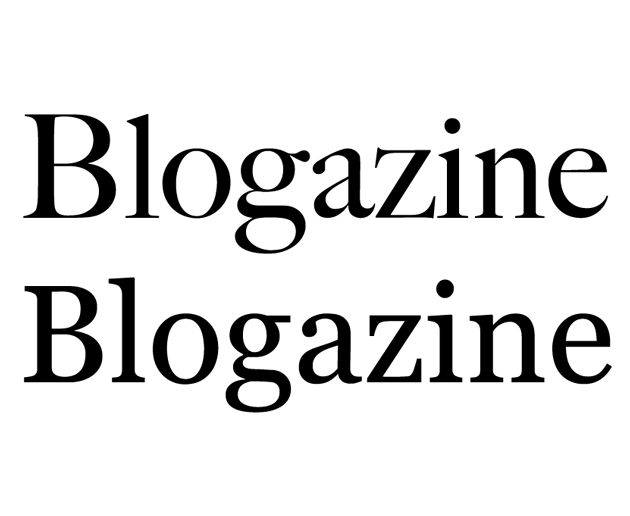
Big Caslon and Georgia, designed by Matthew Carter.

And while we may not notice type much in day-to-day life, the subtle, calculated changes designers make to centuries-old letter archetypes speak to our deepest sensibilities. In the most human of senses, type is personality. Think of the highly stylised “R” in Prada, the formal rigour of Mercedes Benz‘s Kurt Wiedermann-designed “Corporate A,” the iconic script of Alfa Romeo, the cryptic typewriter-look of “Maison Martin Margiela.” The forms of these letters tell you exactly the attitude of the products behind them.

And since computers have infiltrated every facet of life over the past two decades, we’ve all become at least peripherally aware of type’s power. We are able to give style to our written content far beyond that of our own handwriting. Our letters are no longer written in the oppressive uniformity of the typewriter (even though, like using Hipstamatic to fake old film photography, we often insist on Courier to fake retro). We now have a huge degree of control over our written environment through the power of desktop publishing. And as publishing itself is revolutionised by the wireless mobile technology of instant gratification, our personal relationship to type will continue to become richer and more complex.
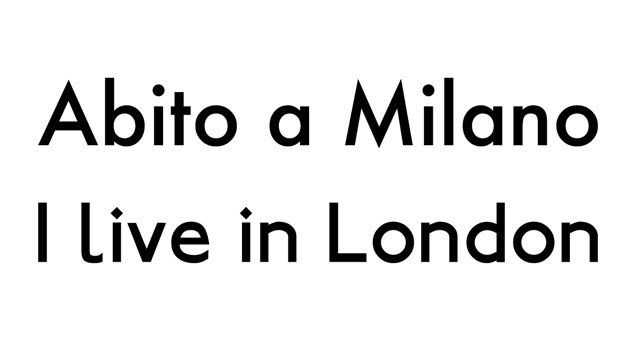
Type is inseparable from place.

Appropriately, type designer Matthew Carter was awarded the lifetime design achievement award by Cooper Hewitt national design museum this month. (And this comes on the heels of a 2010 MacArthur Genius Grant.) Among designers in all fields, his work’s importance was singled out for its huge impact. Like the good, invisible design of “Super Normal,” the book and 2006 Triennale exhibition by Naoto Fukasawa and Jasper Morisson, the power of Carter’s work lies in its unassuming functionality. It is ubiquitous and looked over, even though when measured by use, the infinite reproduction of the internet means he is probably the most prolific type designer of all time.

Chances are you didn’t notice that you’re reading a text set in Georgia. It’s a serif that looks nice both big and small, and without getting into technical mumbo jumbo like “x-height” and “stroke,” it is an absolute masterpiece. Matthew Carter designed it. He also designed Tahoma, Bell Centennial, Big Caslon, and the most widely-used typeface on the internet, Verdana, as well as several others. The names may or may not mean anything to you, but their effectiveness is extraordinary and you’ve most definitely interacted with all of them. As typography nerds who work extensively on the web, we’re very happy to see a type designer honoured with such an enormous award.
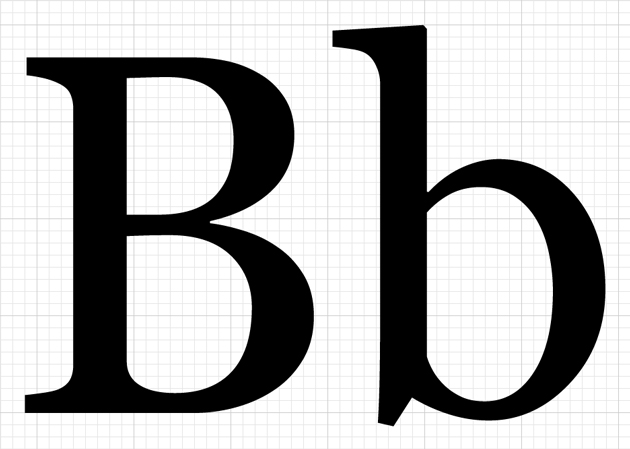
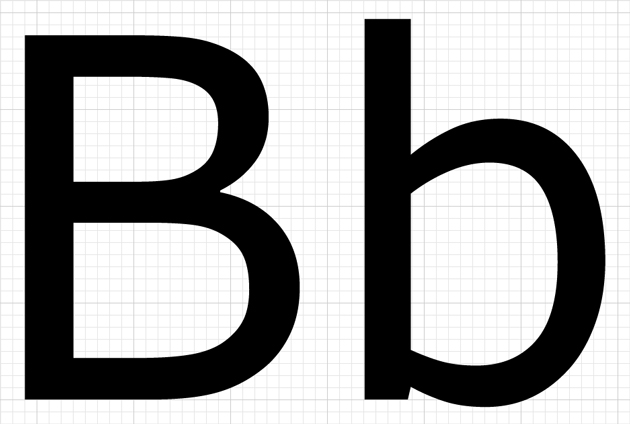
Big Caslon (Top) and Verdana (Above).

Earlier this year, we revealed a new logo as the beginning of a top-secret revolution that’s happening at The Blogazine. We spent weeks in the studio considering typefaces for the logo alongside expert calligrapher Luca Barcellona – we leafed through stacks of 20th century style books and drawers of Luca’s beautiful 19th century wooden type. We wanted a logo that was at once smart, worldly, fashionable, bold and clearly bespoke – essentially, our brand in logo form. Barcellona’s end product combines our signature hexagon with a hybrid B that brilliantly combines elements Gothic and modern type into a powerful whole.

Our identity has been thoroughly enriched.
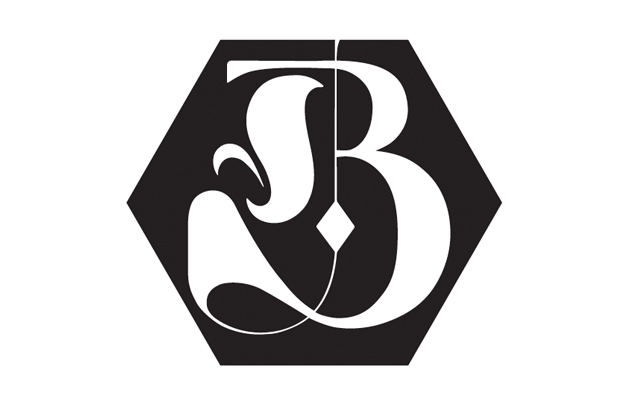
The Blogazine’s Luca Barcellona-designed logo.

Earlier this year, I was stricken by a banner I saw in a newscast that was being brandished by several Egyptian protesters just before Mubarak’s fall. It was scrawled in bubbly characters and looked like it had come straight from a 1940s Warner Brothers cartoon. In its careless presentation, the protesters’ gravely serious message had lost all effectiveness.

Type is personality. Force. It speaks loud, just like fashion. And like fashion, its signs and significance must be taken seriously. Let’s all take a lesson from master Carter and listen to it – and use it – with care.

Tag Christof