09/04/2011

Essen: Teen Delicatessen / Food Porn

.

Essen: Teen Delicatessen / Food Porn

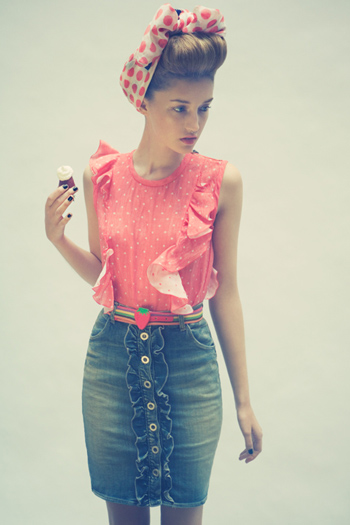
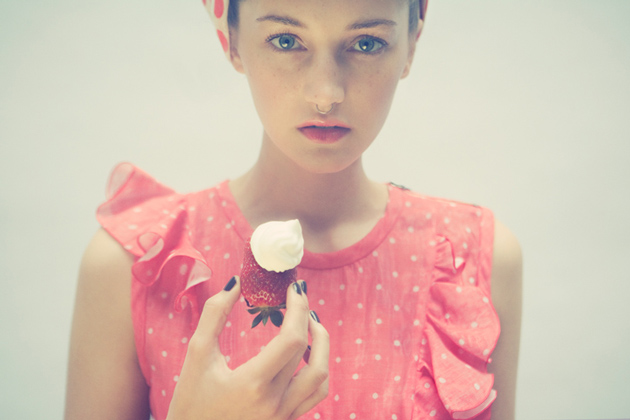
It’s time for spring games. Time to stick fingers into some Chantilly. It’s time for the sensuality of food porn. This editorial is of the season, and loves frosting on strawberries. And to go along with it, we have a very special strawberry recipe for you.

Strawberry Choco Cupcake
2 cups flour

2 cups butter

2 tablespoons of cocoa

1 teaspoon salt

220 g sugar

2 eggs

1 teaspoon vanilla extract

4 strawberries for garnish

Strawberry Frosting
2 cups Philadelphia

1 cup butter

3 cups icing sugar

Pinch of salt

In a bowl, stir together the flour, cocoa and salt.
Melt the butter and sugar together until the mixture is
 fluffy.
Add the eggs, one at a time, making sure to beat them well.
Unite the mixture with flour.

Preheat the oven to 180°C / 350°F

18 and muffin tins lined with paper cups of paper.
Fill the molds with dough, be careful not to fill to the brim, stop at mere.
Bake for 20-25 minutes.
Let cool before decorating.

Beat the butter and Philadelphia until mixed well.
Unite the icing sugar and salt, and beat slowly.
Cool the frosting for about 20 minutes before using it.
Decorate the cupcakes with a pastry bag.
Go wild with the frosting’s form!

Cut strawberries in half and use them to flourish the frosting.

Eat. Feel the pleasure.

Editorial photographed by Nadia Moro and styled by Esmeralda Patisso.

Visit Essen for more fantastic insight into the world of food.

Text Cristina Zaga

08/04/2011

Sandra Suy for Zara

.

Sandra Suy for Zara

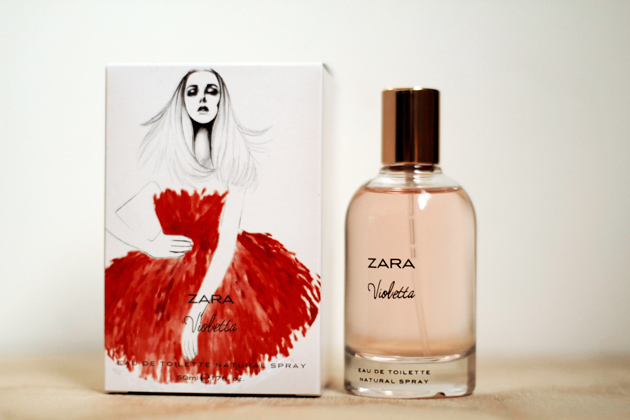
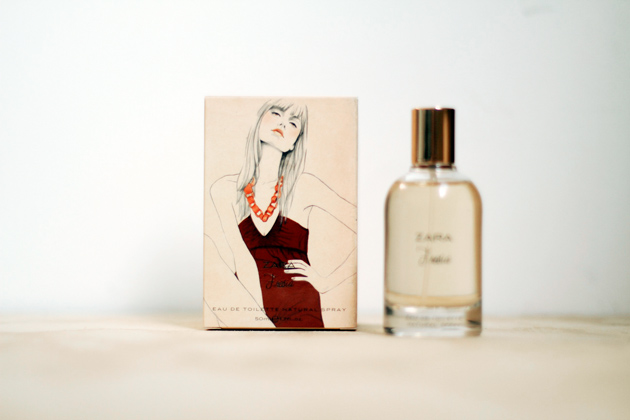
2DM’s illustrator Sandra Suy knows how to work fashion magic. Her girls are fresh, sexy and always really well dressed. And now they’re on Zara shelves the world over – she’s teamed up with the fast fashion giant for a series of four new fragrances including the delicious Fresia and Violetta that we shot here.

Excellent work, Sandra!

Tag Christof

08/04/2011

Guest Interview n°25: Giuseppe Basile

.

Guest Interview n°25: Giuseppe Basile

Domus is one of the world’s foremost design and architecture magazines. Founded by Gio Ponti and first published in 1928, it is an elemental part of Italy’s design and architectural worlds. It is also among the most iconic publications from Milan, having matured through the 20th century alongside its home city, and has experienced its ebbs and flows intimately. It remains a powerful symbol of Milan’s reign as world capital of design, and itself faces down a treacherous path in the coming decades as communication of every form faces radical shifts.


The magazine’s art direction has been on the cutting edge for decades thanks to Giuseppe Basile. From its high-contrast early 1990s look and deliberately “technological” feel of the 2000s through last year’s sweeping redesign, Mr. Basile’s work has always been exemplary. He is, indeed, one of today’s great art directors.
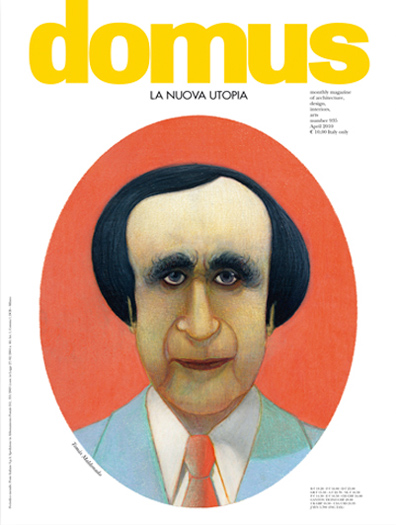
We had the pleasure of meeting with Basile just as Domus once again finds itself in the midst of a drastic redesign, and on the eve of Salone del Mobile – Milan’s defining event. His vast knowledge and sensibilities are a refreshing counterpoint to the transitory, superficial environment we often find ourselves in.

Tell us a bit about your beginnings. Your origins, your education, your career path. How did you get your start as an art director?
I studied at the ISA di Monza, the school wanted by Pagano and Persico to bring the Bauhaus experience to Italy. Those were fantastic years in which I had the possibility to get to know big names in the art world as a student… in the professional world, I gravitated instantly towards magazines, which had been a constant in my life, even if I never ignored other sectors of communication, I always held that the editorial world was and remains the “gym” for a graphic designer.
I arrived at Domus in the 1980s, just after Mendini’s first stint as director… the magazine was then run by Mario Bellini, Lampugnani and Di Battista with some of the most talented (then) young journalists in the world of architecture and design. Pierre Restany coordinated the art, and I had the great fortune of seeing Italo Lupi work as art director. From him I learned much, then little by little, the longer I stayed at the magazine, I met other major graphic designers like Simon Esterson, and most of all Alan Fletcher, which whom I collaborated for five amazing years.
The quick (and deliberate) turnover of directors at Domus meant that I never had to change magazines, because the magazine itself changed every three years. It remains like that to this day. For the future, we’ll see…
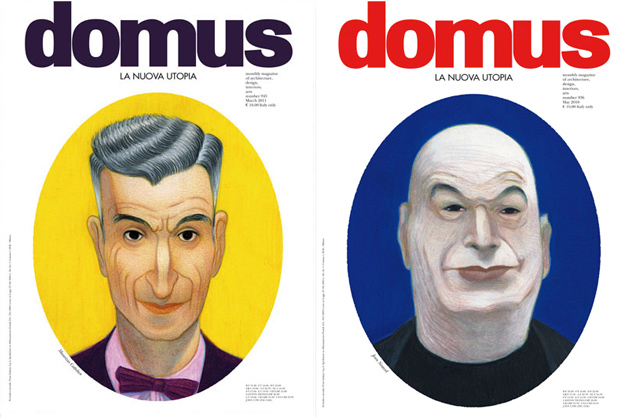
You’re the force behind last year’s stunning redesign of Domus, which coincided with Alessandro Mendini’s installation as director. Give us a bit of background on the drastic change.
It happened one year ago, when the editor asked Alessandro Mendini to confront the massive changes we’re experiencing in communication. He accepted, with a rather monographic vision of the magazine, made up of of eleven publications with a 360° look at the state of planning, architecture, and design in the world: LA NUOVA UTOPIA (The New Utopia).
And it was a unique experience. It gave me the opportunity to get closer to one of the most illuminated minds in contemporary planning for a project we passed over twenty years ago, and that we assumed would never have the chance to reach fruition. Mendini prepared Domus for the “new era,” which is now being undertaken by the young, intelligent and determined architect Joseph Grima, who will have the difficult job of reinventing the magazine in the world of new technologies in communication.

Since Mendini’s deliberately short stay has come to its end with the last issue, #945, can we expect another complete redesign anytime soon?
Like I mentioned before, the change is already underway. Grima will bear the torch of Domus for the future with a sharp eye on the contemporary and on technologies that will have an impact on the world of architecture, design and planning.
Now we’re preparing the new project, and the premises are really very interesting. Salottobuono and the company directed by Grima are developing a project that is a real pleasure to be a part of. Naturally, there will be many changes – these last eleven issues were “one-offs.”
Grima’s vision is different, and it will be unveiled in the next few days within the context of the grand events of Salone del Mobile.
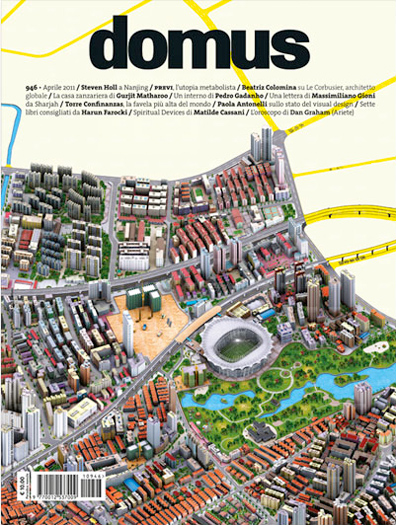
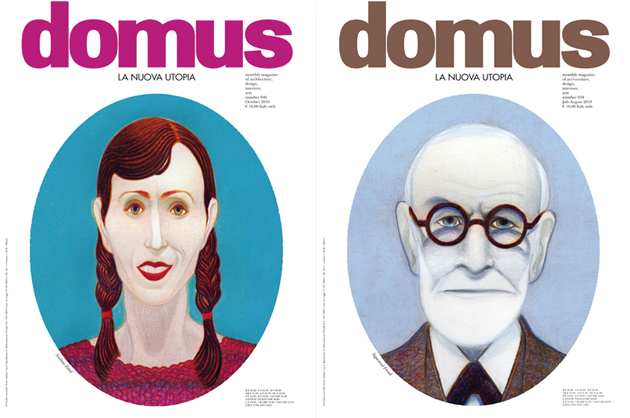
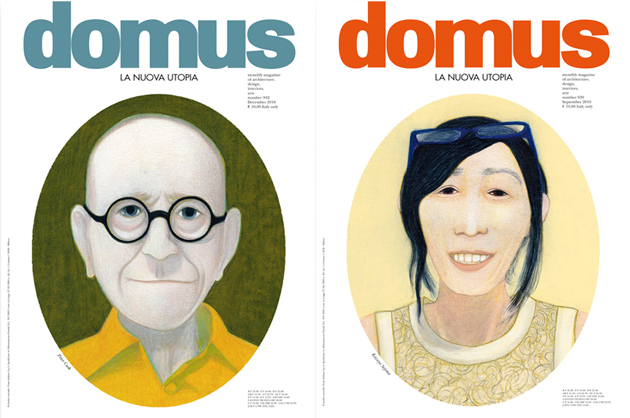
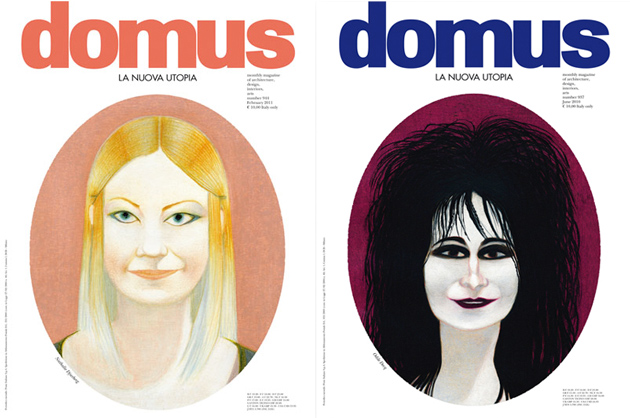
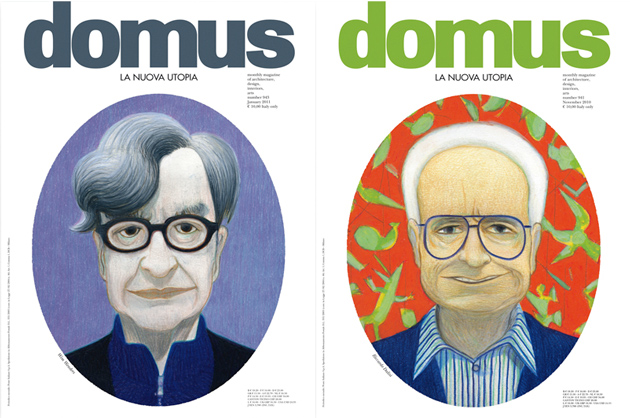
The most striking part of the last redesign remains the Lorenzo Mattotti portraits that have adorn the cover of the past year’s issue. Explain the decision to feature the portraits rather than imagery more directly related to contents?
Thirty years ago, when Mendini left Domus for the first time, he characterised his own direction with covers outside the “chorus,” which had lasting effects on art direction. In fact, he was the first to adopt the portrait in a systematic way for an architecture magazine. Back then they were photographs: pieces of artistically retouched “optical magic.” So, once again director, he wanted to revisit a discourse that had been abandoned as “suspect,” but with a new style. So he arrived at illustration, and the choice was made to commission Mattoti, probably the best-known Italian illustrator abroad.
The most interesting thing was the challenge of asking an artist whose style we liked, but who had never made portraits to make portraits! He accepted the experiment immediately, without hesitation and the result was perfect.
At the beginning the choice of these eleven portraits remained to be made, but once Maldonado was chosen (for the first of the issues), it became a natural progression.

What is working at Domus like? Is there a sense in the company that you’re the stewards of Gio Ponti’s legacy?
Of course. It has always been very gratifying to contribute to a project that has lasted for more than eighty years. Like I mentioned before, it gave me the opportunity to meet exceptional people, and that is the most that one can hope for from his profession because it permits you to keep growing.
Even today, with the this last experience with Alessandro Mendini, I was improved, enriched and surprised at the discoveries, and I don’t just mean on an intellectual level.
I consider this a real fortune.
Domus’ identity is wrapped up in the identity of Milan itself. Where do you see Milan in the grand scheme of things in today’s dramatically changed world?
Milano in the 1970s and 1980s was often referred to as the “Mecca” of design. That means that we have a heavy heritage to stack up to, and since we know when things are going well, the bad things are harder to see. Those things, which today are very present, leave it up to us to show that we deserve that heritage. And to do that, we must be even better than we were in the past.
What long-term impact do you think the 2015 Expo will have on the city? Its identity?
It’s difficult to express the difficulty with which everything is progressing for the Expo 2015 project. A huge opportunity has knocked on our door in a moment of extreme economic and social drama. This is a strong reason, thought that it must be overcome through our capacity for doing. Everything depends on how the operation will be managed, and only then can we really know anything about the impact it will have on the city.

Art direction can, paradoxically, be an invisible job. You’re charged at once with crafting a publication’s distinctive style while making sure that your work doesn’t distract or detract from contents. What do you consider your ‘signature’?
I don’t think it’s an invisible labour. I think the opposite: that we almost always tend to look solely at the aesthetic side to the detriment of content, and this puts us graphic designers in the front row. And in the line of criticism.
I think that art direction must be subordinate to communication, i.e. the content (nothing is really beautiful if its its separated from its contents, according to Charles Eames, but there’s a middle ground to be found). As in an orchestra, there are fundamental instruments that must be present and those that must be, let’s say, “discretely present” to play on their proper strengths. This is an ambitious result that is not always achieved… but when it’s like that, I’m happy with my work.

So, just how adventurous can an art director be while still effectively getting the publication’s message across?
Obviously, personal capacity is fundamental (this should be implicit in this question), but everything depends on the reader: the more illuminated he is, the more the art director can push himself forward. You’re lucky to have an audience that allows for uncensored possibilities, otherwise adventure would be downright reckless.
With everything from I.D.’s demise to the New York Times inevitable web-only future and a flooding of new tablet-based magazines, where do you see magazines a decade from now?
The calendar you’re asking me for is only in the agenda of people like Steve Jobs. It all depends on how technology will … . In fact, almost everything depends on this, so it will determine the acceleration of events. For our part, we can manage contents, but the case of NYT is simply a technological question. Giving news once a day obsolete when applications are updated in real time.
When you go deeper, it’s different. Criticism and research which naturally need time give the possibility of differentiation of mediums. The web has taken its place in the world, and will become powerful just like all the other means of communication in their own time… this of course will clean up the editorial world’s paper version.
But it is possible if well managed that magazines will become the reference point of these ten incredible years. This is a crucial point of the debates that are unfolding right now all over the world.

If you had to choose one typeface to use exclusively for the rest of your career, what would it be? (We’re stricter than Vignelli!)
Oh, Vignelli! I find that being able to express your own graphics using one or two fonts (like in the case of Vignelli, but also of Fronzoni and others) is naturally to make first-rate works. It is a measure of talent and capacity. It is one of the elements that characterises many of the “masters.” Still, many have shown an exceptional expressive capacity using as many as possible and exploiting huge creative possibilities in typography…Lubalin, Chermayeff, Fletcher, and Italo Lupi in Italy.
Me for my work, I have always followed and appreciated both schools of thought, but I have to say that I love all typographies. In every typeface, I find reason to fall in love, even in sheets of paper cut into characters… think of Matisse!
In your opinion, what is the most beautiful magazine in the world? (Other than Domus!)
I’m enticed by “mythical” magazines that have changed the world and our way of thinking…
Those which have the best contents, in all senses…

Introduction and Interview Tag Christof – Translations Helga Tripi & Tag Christof
08/04/2011

#milanuncut

.

#milanuncut

The Blogazine supports #milanuncut.

The Twitter hashtag initiative was begun by a group of design journalists to debate serious issues in design that generally don’t grab headlines. Environmental and social issues. Education issues. Product life, aesthetics, materials and even issues related to the design system itself. And on the eve of the world’s most important design event – which just happens to be the crown jewel of our city – we feel that design is in need of a real shakeup. Questions raised on #milanuncut will serve to stimulate real discourse and drive design towards better solutions and away from a tool for the far-too-market oriented nature of pretty trinkets and shiny brand names.

fuesproject and other notables have already been quite active in the discussion, and we invite our readers to join in. London design practice Zerofree designed the #milanuncut logo.

Follow The Blogazine on Twitter at @2dmblogazine

Tag Christof

07/04/2011

Diego Soprana Gets Glamorous

.

Diego Soprana Gets Glamorous

The newest work from 2DM’s Diego Soprana is a surprising departure from his norm. Usually a maker of rigorous and surrealist imagery, the young illustrator has never ceased to amaze us. But these understated and very elegant images highlight his versatility as an artist and demonstrate his breadth of talent.


With this additional direction, he displays an uncanny sensitivity – something that his usual subversive collage work does in an entirely different way. From the Dior chemise, to the Chanel perfume and sophisticated silhouettes, these are pure style. They are filled with midcentury glamour, solid colour palates, imperfect brush strokes and delicate proportions. Think early motion picture animation. Think Mad Men. Nights out on the town captured in Kodachrome. You can almost see them in a 1960 Bergdorf Goodman window…

Tag Christof – Images 2DM/

07/04/2011

Revista Rara | Guatemala

.

Revista Rara | Guatemala

Guatemala probably doesn’t blip your radar when you think of design, art or good magazines. In this small country where political controversy and violent scandals are top of mind, high quality, incisive publications can be very rare finds, indeed. But with a clean and fresh perspective, Revista Rara manages to be an exceptionally good digest of design, art, architecture and culture. Made by a team of only native Guatemalans, this is a gutsy, fresh and well-curated magazine that wouldn’t be out of place on the newsstand of colette or any other discerning magazine stand. Seriously, it’s that good.


This month marked the launch of Rara’s third issue, and not only is the art direction fantastic by any standard, the magazine has a distinctive voice that is the result of its sharp eye and the culture that surrounds it. The magazine is filled from end to end with Guatemalan talent from the likes of Cedrick Arenales, Juan Brenner or Byron Mármol. The publication’s vision is specially focused on Guatemalan and Latin American projects, and gives us an interesting insight into the creative atmosphere in this oft-overlooked corner of the globe.

RARA’s creators, Andrés and Luisa, are both passionate artists and work from a “genuine and passionate Central American point of view.” From their work you readily really tell that the team they have put together operates for no higher purpose than to carry out their passions. They write, photograph, paint and generally create because it’s what they love to do.

And the magazine’s title couldn’t possibly be more appropriate: rara in Spanish means rare, unique and weird. But the only thing rara about it is that you can’t find it outside Central America. It’s gorgeous to real creativity sprout up in an unexpected place. Maybe it’s about time we shift our perceptions and look beyond our borders a little more willingly… there are treasures to find!

And so, we think RARA deserves a hearty cheer, Guatemala style: RA! RA! RA!

Juan Alvarado & Tag Christof – Special thanks to RARA

06/04/2011

Architect Barbie Does Milano

.

Architect Barbie Does Milano

Barbie has worn many hats in her long life. Mostly frilly ones, berets, and the kind fancy ladies wear when they go “skiing” in Cortina, but mostly just sit in the lodge and drink hot chocolate. Now, though, she’s donning a harder hat. After being everything from an astronaut to a corporate executive, Barbie’s career trajectory has finally taken a turn we can get into. She’s become a maker-innovator with the release of her latest incarnation: Architect Barbie.

For 2011 she’s taken on a career that’s eminently 21st century and in line with the forward-thinking ladies of today. With Barbie’s obvious appreciation for design – think pink Corvette convertibles and well-furnished plastic mansions – it’s surprising that it’s taken her this long to realise her passion for the built world. And since she’s been in the fashion game her whole life (and has a bigger wardrobe than Franca Sozzani, Anna Wintour and Anna dello Russo combined), it’s about time she used her highly cultivated taste and sense of style to solve some pressing problems. And we’re very happy that our hot plastic friend has broken the glass ceiling of one of the last remaining male-dominated professions.


So, Architect Barbie has arrived to do battle with the likes of Zaha Hadid, Eileen Gray, Kazyuo Sejima and other female luminaries of our day. What will she call her practice? Barbitecture? Will she trade in her subscription to Glamour for Domus and Architectural Digest? And we can only imagine the kinds of buildings she’ll dream up. While she’ll likely be behind some seriously well-executed shopping malls, we hope she’s passionate about urban housing and radical public green spaces, too.

In honour of Salone Del Mobile, Barbie paid us a visit and let her hair down for a whirlwind tour of Milan’s famous architecture. Once we managed to get her out of La Galleria and away from Piazza Duomo, she went absolutely crazy for Torre Pirelli. But Torre Velasca scared the living daylights out of her. And at the end of the day, she proclaimed that she was “so over pink,” thinking about switching to biodegradable plastic, and that Gio Ponti is her new hero.

Now you’re talking, Barbie.

Text and photos by Tag Christof – Very special thanks to Sofia La Rosa
05/04/2011

Ana Murillas / The Seventh Seal

Ana Murillas / The Seventh Seal

The second issue of Spanish culture biannual Tiger Magazine is on newsstands. The jumbo journal’s sophomore foray – The Cinema Issue – is even better than its first time out, with interviews with the likes of Olly Alexander, an excellent piece on Diane Pernet, and work by photographers Rankin, Jonathan Hallam, Miguel Villalobos and JM Ferrater. But mostly we love this issue because you can see the work of 2DM’s super stylist Ana Murillas en grande. She did the fashion for an editorial with photographer Richard Jensen based on Ingmar Bergman’s 1957 film The Seventh Seal. With its rocky seaside backdrop and early morning light, Ana and Richard do a fantastic job of bringing the solemn, spiritual mood of the film into fashion.

As a bonus, catch the fun illustration of Ana at the opening of the issue.

Tag Christof 
04/04/2011

The Editorial: Hugh Holland and The Lost Art Of Living

The Editorial: Hugh Holland and The Lost Art Of Living

The world over, cities are crawling with glossy girls and prissy boys whose only aim in life seems to be to perfect their appearance. It’s easy to blame fashion, especially from the outside, but the real culprit is much larger, and the exact opposite of fashion. Blame a well-oiled marketing machine, terribly misguided values (embodied in terribly misguided pop stars), and a fragmented Western culture mostly devoid of nagging discomforts…

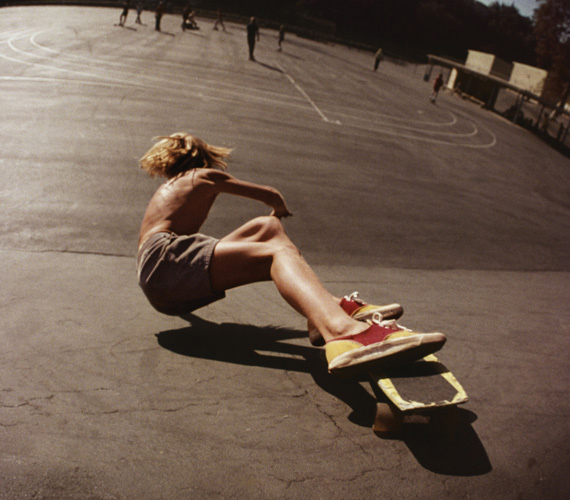
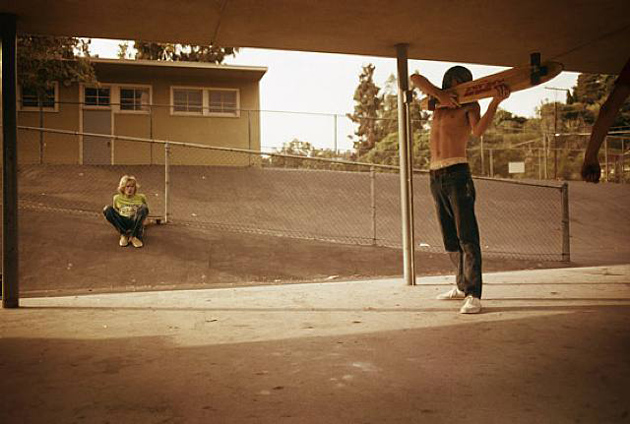
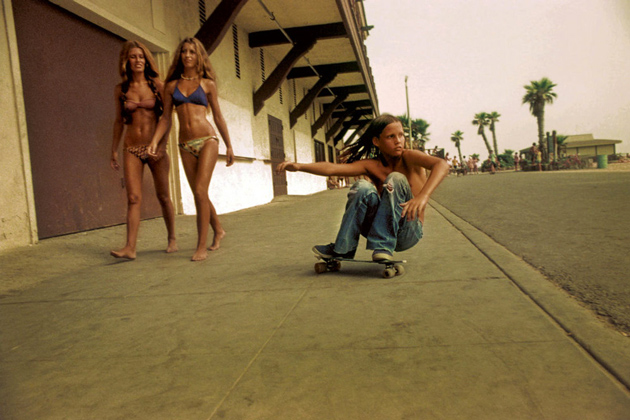
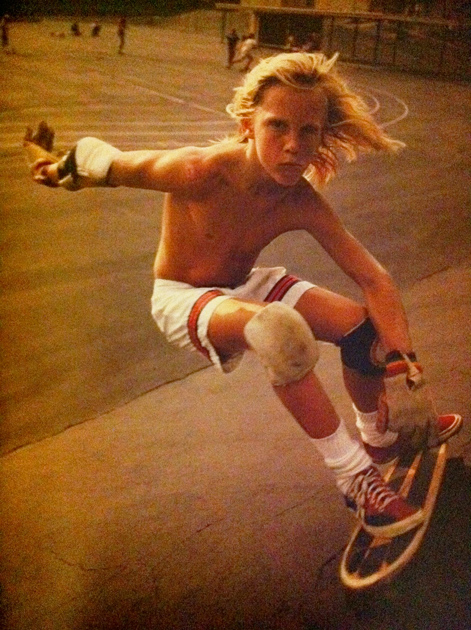
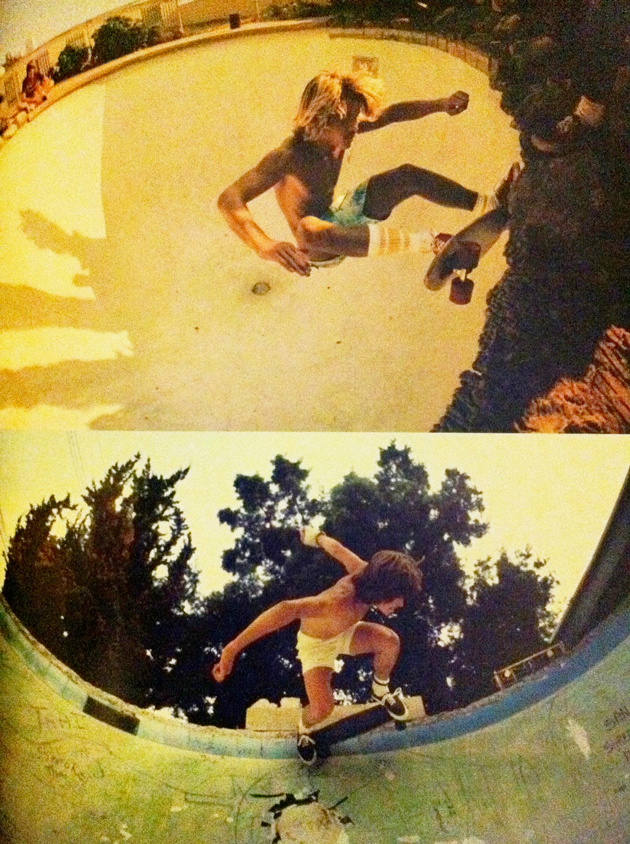
We recently came across Hugh Holland’s 1970s photographs of Southern California kids who lived life on the decks of skinny, precarious banana skateboards. They commandeered dry swimming pools, they wore tattered Vans and had suntans. Theirs was a beauty that burst from within. Their exuberance and lust for life was boundless – and captured gorgeously by Holland, who was himself interestingly not a skateboarder. He could see that these kids were alive!

Most striking about Holland’s photos, though, is just how sharply their exuberance and energy contrasts with the pretence of today. Sure, more kids skate now, but it’s only because marketing types seized on the sport’s potential. Endorsements. Video games. And now every suburban kid and pretentious fashion victim worth his salt is somehow a skater, bro.

Going down to the stake park is no longer about the art of skating. It’s about trash talk and showing off your jeans. And the days of the banana board and California sunshine are over: not only do kids no longer roam the streets in search of adventure, they aren’t allowed to venture beyond their front doors without a helmet and fifteen kilos of other protective gear. Is this overprotectiveness the root of the problem? What harm did a healthy scratch do? And in an age of preteen Starbucks patrons, maybe its our inability to be kids – and our inability to let our kids be kids – that keeps us from living openly and exuberantly. Who knows.

So, instead of getting out there and pioneering and exploring in search of something truly new, we only seem to be capable of remixing that which came before. Without a moment’s thought about the lifestyle the look was born of, we dress like skaters. Or strap on a pair of Doc Martens we just bought with daddy’s credit card and claim to be punk. (You’re not punk. Full stop.) Or worse still, we copy something that means absolutely nothing. And we take photos of ourselves on the and post them to Lookbook, hoping desperately that someone will validate our desperation with “hype.” Except those hype points… well, if you say so!

Now, we don’t pretend to have a problem with appearance. On the contrary, in fact. But, shouldn’t a look be the result of a life lived? Of a passion? Of a belief? Your own?

Perhaps our old pal Vivienne Westwood said it best when she proclaimed that ‎”Johnny Rotten and all the others were a bunch of conformists. It’s not green hair that makes you different, it’s your brain, your attitude towards life.”

You’ve got that right, Viv.

Catch Holland’s book, Locals Only, at Ammo Books.

Tag Christof – Images courtesy Ammo Books 
02/04/2011

Essen: Curious Beasts – An Introduction to Small Game

.

Essen: Curious Beasts – An Introduction to Small Game

As cuisine becomes more and more localized chefs have increasingly touted the benefits of utilizing local flora, and rightly so. Home cooks are increasing the foraging ranks, and chefs from California to Scandinavia enlist teams of natural scavengers to adorn their seasonal menus with the best of local vegetation. Many local animal food sources, however, are often overlooked, be it for cultural, taste or availability reasons. But there is evidence that the hunting and eating of wild game is slowly taking hold.

In a constant effort to challenge perceptions of what food is, while simultaneously exploring new flavors and sensations, chefs like Brett Graham and Heston Bluementhal are naturally directing our attention to the world of fauna. What better way to challenge perceptions than with animals that are often perceived as inedible, road kill, or just downright disgusting.

In an effort to discover more about eating wild game, I had a chat with Baron Ambrosia, the star of the food show Bronx Flavor, and the host of the First Annual Bronx Pipe Smoking Society’s Small Game Dinner, held in January. The purpose of the dinner was to challenge chefs to get out of their comfort zones by preparing main dishes using unusual game, and to give guests the opportunity to explore the world of protein, outside of what is usually deemed as acceptable. And the results? The menu included such delicacies as opossum with dried pepper sauce, squirrel with black truffles, and a raccoon confit.

When asked what triggered his own interest in hunting and eating small game Baron Baron responded, “Out of the vast selection of fauna that is available (and delicious) we as a society are politely permitted to choose from a very small selection. Much of this selection is unhealthy industrial-grade offal. People are perfectly happy to pick up a hamburger made from a cow that has spent its miserable life in a dank pen being overstuffed with corn and antibiotics, yet they recoil in horror at the thought of consuming an animal that has had a beautiful and productive life in the wild.”

For those of us not lucky enough to be on the Baron’s guest list, our best option is probably heading down to the farmers’ markets to see what game is available, or availing ourselves of a hunting license. However you obtain that wild meat, the Essen guide to small game should serve as an excellent source of inspiration.

Visit Essen for more fantastic insight into the world of food.

By Eileen Bernardi – Illustrations by Lorenzo Fernandez